Workflow automation uses software to carry out repeatable business processes with less manual work. Learn how it works, the main approaches, and where AI fits.
In Agentic AI, workflow automation refers to the ability of autonomous agents to initiate, execute, and adapt business processes without rigid, pre-coded rule sets or manual oversight. Unlike traditional automation, these workflows are dynamic, goal-driven, and continuously optimized through real-time agent collaboration.
Quick Answer
Workflow automation uses software to carry out repeatable steps in a business workflow with less manual intervention. It can move information between systems, trigger tasks, apply rules, request approvals, route exceptions, and complete actions according to how the workflow has been designed.
Workflow automation can range from fixed, rules-based processes to more adaptive approaches that use machine learning or AI agents. The right approach depends on how predictable the work is, what decisions are required, and where people still need to review or intervene.
What is workflow automation?
Workflow automation is the use of technology to execute and coordinate some or all of the steps within a workflow. Instead of relying on people to manually move work from one task or system to the next, software can trigger actions, transfer information, apply decision logic, and route work according to defined conditions.
A workflow is simply a sequence of connected activities needed to complete a piece of work. It might involve one application or several, and it may include automated tasks alongside approvals, reviews, or exceptions handled by people.
Business workflow automation is commonly used for processes such as invoice handling, employee onboarding, claims processing, customer requests, approvals, document routing, and data updates.
The amount of automation can vary. Some automated workflows follow the same path whenever a known trigger occurs. Others use AI to interpret information or help determine what should happen at a particular stage.
Workflow automation systems therefore do not need to remove people from a process entirely. Their purpose is to automate work that can be handled consistently while making it clear where human judgment, approval, or intervention is still required.
How does workflow automation work?
Workflow automation typically begins with a trigger, applies rules or decision logic to determine what should happen next, executes the required tasks, and continues until the workflow is completed, paused for approval, or routed as an exception.
A typical workflow automation process can include:
- Trigger: An event starts the workflow, such as receiving a form, uploading a document, creating a new record, reaching a deadline, or changing the status of an existing case.
- Decision logic: Rules, models, or other logic determine which path the work should follow.
- Task execution: Software performs actions such as creating records, sending notifications, validating information, updating applications, or generating documents.
- System handoff: Data or work moves between applications through integrations, messaging, or APIs.
- Approval or exception: The workflow can pause or change direction when a person needs to review a decision or when something falls outside expected conditions.
- Completion: The final action is recorded and the workflow ends, or another process is triggered.
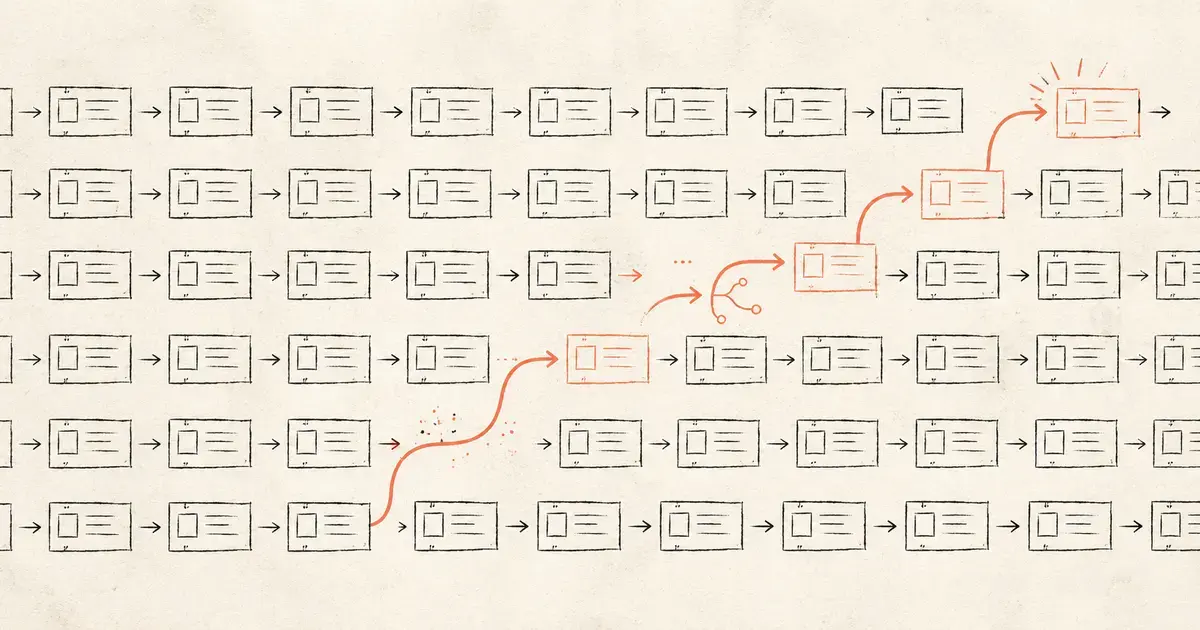
The path does not always have to be linear. A workflow can contain parallel tasks, conditional branches, retries, approval loops, and different routes depending on the information available.
Reliable workflow automation therefore depends on more than automating an individual task. The connections between tasks, systems, decisions, and people also need to work consistently.
What approaches are used in workflow automation?
Workflow automation can use rules, robotic process automation, AI models, or AI agents depending on the kind of work being performed. Many enterprise workflows combine more than one approach because different steps require different levels of judgment and flexibility.
Common approaches include:
Rules-based automation: Uses predefined conditions to determine what happens next. It works well when the process is stable and the possible outcomes can be specified in advance.
Robotic process automation (RPA): Uses software bots to carry out repetitive tasks, often by interacting with applications in ways similar to a human user.
Model-assisted automation: Uses machine learning or AI models for specific steps such as classification, prediction, extraction, or recommendation while the wider workflow remains predefined.
Agentic workflow automation: Uses AI agents that can interpret context, determine steps, use tools, and adapt the workflow within defined boundaries. Agentic workflow automation is most useful where the process cannot be fully represented by fixed rules alone.
These approaches can coexist within the same enterprise workflow automation environment. A process might use rules for eligibility checks, an AI model to classify an incoming document, RPA to update an older application, and a person to approve an exception.
Modern AI & automation environments increasingly bring these approaches together rather than requiring every workflow to use one form of automation from beginning to end.
How is workflow automation different from business process automation, RPA, and workflow orchestration?
Workflow automation focuses on automating connected steps within a workflow, while business process automation addresses broader end-to-end processes, RPA automates repetitive tasks, and workflow orchestration coordinates how different tasks, systems, and automation components work together.
| Term | Main focus |
| Workflow automation | Automates and coordinates steps within a workflow. |
| Business process automation | Automates or improves a broader business process that may contain multiple workflows. |
| Robotic process automation | Uses software bots to perform repetitive tasks, often through existing application interfaces. |
| Workflow orchestration | Coordinates the sequence, dependencies, systems, and automation components involved in executing work. |
The distinctions are useful because automating one task does not necessarily automate the workflow around it. Likewise, several automated workflows may form part of a much larger business process.
Orchestration becomes especially important when workflows span multiple systems or use different forms of automation. Agent orchestration applies a similar coordination principle when AI agents, tools, and tasks need to work together toward a larger objective.
Intelligent automation is another related concept that combines automation with technologies such as machine learning, AI, and decision systems to handle work that requires more than fixed process logic.
What makes workflow automation effective in an enterprise?
Effective workflow automation starts with a process that is understood well enough to define what should be automated, what systems are involved, where decisions are made, how exceptions are handled, and where people still need to intervene. Technology alone cannot compensate for a workflow that is unclear or poorly designed.
Reliable integrations are one requirement. Automated workflows often depend on several applications, databases, or external systems. If those connections are fragile or information cannot move reliably between them, the workflow can fail even when its automation logic is correct.
Decision points also need the appropriate kind of automation. Fixed rules are useful when conditions are predictable. AI models or agents may be more appropriate where information needs to be interpreted before the next step can be determined.
Exceptions need to be designed from the beginning rather than treated as failures that will rarely occur. A workflow should define what happens when data is missing, a system is unavailable, an approval is delayed, or a case falls outside the normal path. Human-in-the-loop controls can provide review points where judgment or authorization is necessary.
Good process engineering also helps establish the sequence of work, dependencies, handoffs, escalation paths, and operating boundaries before automation is introduced.
Once deployed, the workflow still needs ownership and monitoring. Enterprises should be able to see where work is slowing down, how often exceptions occur, whether integrations remain reliable, and whether the automation is producing the operational improvement it was intended to deliver.
Continue Exploring
Enterprise workflows rarely need the same kind of automation at every step. Understanding the process, decisions, integrations, exceptions, and human review points can help determine where rules are enough and where more adaptive automation can add value.
Explore where automation can remove unnecessary manual work while keeping the right controls around the decisions that matter.
Related Reading
Enterprise Workflow Automation in 2026: Rules, Models, or Agents?
Enterprise workflows can combine predictable rules, AI-assisted decisions, and more adaptive agentic automation rather than relying on one technology throughout the process. This article examines where each approach fits and why the nature of the work should determine the automation used.
Intelligent Invoice Processing for High-Volume AP Operations
This case study shows workflow automation operating across document extraction, classification, business-rule validation, routing, exception handling, and enterprise-system integration. It provides a practical example of how deterministic automation, AI capabilities, and human review can work together within one business process.
Related Questions
Can workflow automation include human approvals?
Yes. Workflow automation can automate the steps before and after an approval while pausing whenever a person needs to review, authorize, or make a decision. Human approvals are often built into workflows where financial, regulatory, operational, or customer consequences make fully automated execution inappropriate.
The workflow can automatically collect the required information, route it to the correct reviewer, record the decision, and continue along the appropriate path afterward.
Can one workflow combine rules, AI models, and AI agents?
Yes. Different parts of the same workflow can use different forms of automation depending on the task being performed. Rules may handle predictable decisions, AI models may classify or extract information, and AI agents may be used where the next step depends on changing context.
Using several approaches does not require the entire workflow to become agentic. Each step can use the simplest form of automation capable of handling it reliably.
Can workflow automation work with legacy systems?
Yes. Automated workflows can interact with legacy systems through APIs, middleware, databases, integration layers, or RPA where direct interfaces are limited. This can allow enterprises to automate work across older and newer applications without replacing every underlying system first.
Legacy constraints can still affect what is possible. Limited interfaces, slow response times, inconsistent data, or fragile integrations may restrict how reliably the workflow can operate.
How should workflow automation handle exceptions?
Workflow automation should define how exceptions are detected, routed, reviewed, retried, or escalated before the workflow goes into production. Common exceptions include missing information, failed integrations, conflicting data, unavailable systems, or cases that fall outside normal decision rules.
Some exceptions can be resolved automatically, while others should move to a person with enough context to understand what happened and decide how the work should continue.
How do enterprises measure whether workflow automation is working?
Enterprises should measure workflow automation against the operational result the workflow was intended to improve. Useful measures can include processing time, manual effort, error rates, exception rates, throughput, cost, turnaround time, and whether service or operational targets are being met.
The right measures depend on the workflow. Automation that moves work faster but creates more exceptions or manual correction may not represent a genuine improvement.