Quick Answer
Agent orchestration is the coordination logic that decides how work is divided among AI agents, which agent acts next, what each agent needs to know, and how their outputs are combined into a final result.
It is especially important in multi-agent systems, where several specialized agents must work in the correct order, respect task dependencies, avoid duplicating effort, and resolve incomplete or conflicting outputs.
What is agent orchestration?
Agent orchestration is the process of allocating, sequencing, and coordinating work across one or more AI agents. It turns separate agent capabilities into an organized execution model with defined roles, dependencies, and completion rules.
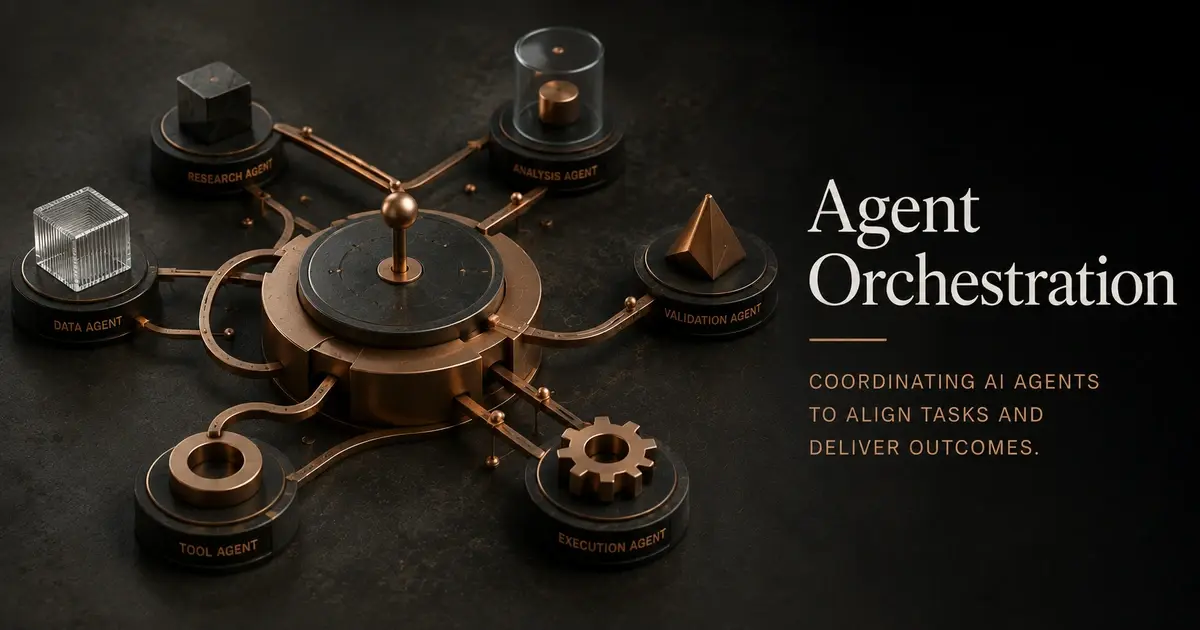
Consider a system with agents specializing in research, classification, validation, and final review. Agent orchestration determines whether those agents work one after another, operate in parallel, or remain inactive until a specific condition is met.
The orchestrator can also decide:
- Which agent is qualified to handle a task
- What portion of the task each agent receives
- Which outputs must be completed before another agent begins
- What information is passed forward
- When an agent should retry, stop, or return control
- How several outputs are reconciled
- What conditions indicate that the work is complete
This is narrower than agentic workflow automation. A workflow describes how a business process moves from an initial request to an operational outcome. Agent orchestration focuses on how agent responsibilities are coordinated inside that process.
The Enterprise Guide to Agentic AI places this coordination layer within the broader operating foundation, including workflow boundaries, governance, observability, secure tool access, and readiness for production deployment.
What decisions does an agent orchestrator make?
An agent orchestrator makes execution decisions about assignment, timing, dependencies, and resolution. Its purpose is to ensure that the right agent performs the right work at the right point in the process.
The most important orchestration decisions include:
Task allocation: The orchestrator selects an agent based on its role, available tools, permissions, domain knowledge, or model capability. A financial analysis task, for example, should not be routed to an agent designed for document extraction simply because both agents can process text.
Execution order: Some tasks must happen sequentially. A validation agent cannot check a recommendation until another agent has produced it. Other tasks can run in parallel. Several specialist agents might independently analyze pricing, risk, and operational impact before their findings are combined.
Dependency management: The orchestrator tracks which tasks rely on earlier outputs. If one required result is delayed, missing, or unusable, dependent work should not continue blindly.
Context distribution: Each agent should receive the information needed for its role, rather than the entire workflow history by default. Careful context distribution reduces confusion, cost, and the risk of exposing unnecessary data.
Completion and stopping: The system needs a clear definition of done. Without termination conditions, agents can repeat analysis, keep delegating work, or continue refining an answer without producing additional value.
An AI orchestration platform typically provides the runtime and control mechanisms used to execute these decisions across agents, models, tools, and services.
What orchestration patterns are used in multi-agent systems?
Multi-agent systems use different orchestration patterns depending on whether work needs central control, specialist collaboration, parallel analysis, or layered delegation. No single pattern is suitable for every problem.
Common patterns include:
- Supervisor–worker: A supervisor agent assigns tasks to specialized worker agents, evaluates their outputs, and decides what happens next. This pattern offers clear control and is useful when one coordinating role should remain accountable for the overall result.
- Sequential pipeline: Each agent completes one stage and passes its output to the next specialist. This works well when the task has a known dependency chain, such as extraction followed by validation and then classification.
- Parallel specialists: Several agents examine the same problem from different perspectives at the same time. Their outputs are later combined, ranked, or compared. Parallel execution can reduce latency, but it requires a reliable method for resolving differences.
- Hierarchical orchestration: A top-level orchestrator delegates groups of tasks to secondary coordinators, which then manage their own specialist agents. This pattern can support larger systems, though each additional layer makes traceability and cost control more difficult.
- Event-driven coordination: Agents respond when an event or state change occurs rather than following one fixed chain. This approach suits environments where new information arrives asynchronously and different agents act only when their conditions are met.
- Peer collaboration: Agents communicate directly and decide collectively how to divide the task. Peer models can be flexible, but they are harder to govern because responsibility for routing and final resolution is less centralized.
A micro-agent architecture often uses narrow agents within one or more of these patterns. The smaller each role becomes, the more important orchestration is in preventing fragmentation and unnecessary coordination overhead.
How does agent orchestration manage state and dependencies?
Agent orchestration relies on shared execution state to track what has been requested, completed, rejected, or left unresolved. Without reliable state management, agents can work from stale information, repeat completed tasks, or act before their dependencies are ready.
State can include:
- The original objective
- Tasks already assigned
- Current task status
- Outputs produced by each agent
- Failed or rejected results
- Decisions awaiting review
- Available budgets or time limits
- The current version of shared information
A well-designed orchestrator does not simply forward every message from one agent to another. It records structured information about the execution and supplies each agent with the state relevant to its task.
Dependency management builds on that record.
If a recommendation depends on three specialist reviews, the orchestrator should confirm that all required reviews are complete before proceeding. If one review fails, it should know whether to retry, replace the agent, continue with reduced confidence, or stop the process.
State management also prevents circular delegation. An agent should not repeatedly return the same unresolved task to another agent without a rule that changes the execution path.
These controls become more important as multi-agent architecture grows. A system with two agents may be understandable through simple message passing. A system with dozens of agents requires explicit state, dependency graphs, and execution records.
How are conflicting agent outputs resolved?
Conflicting outputs are resolved through predefined arbitration rules rather than allowing agents to debate indefinitely. The resolution method should match the importance of the decision and the reliability of the agents involved.
Several approaches are possible.
Rule-based arbitration
A fixed rule determines which output takes priority. For example, a compliance agent may override a commercial recommendation when a policy restriction is identified.
Confidence comparison
Outputs are compared using confidence scores or validation checks, and the strongest supported result is selected. Confidence should not be treated as proof on its own. It is more useful when combined with evidence quality and task-specific validation.
Specialist review
A separate evaluator agent checks competing outputs against defined criteria. This creates separation between generating an answer and deciding whether the answer is acceptable.
Consensus
The system proceeds only when a required number of agents agree. Consensus can be useful for some analytical tasks, but agreement does not guarantee correctness when agents rely on the same flawed source or model.
Human decision
The workflow pauses when disagreement affects a high-risk or materially important outcome. The reviewer should receive the competing outputs, supporting evidence, and a clear explanation of why the system could not resolve the conflict.
Orchestration should also recognize when apparent disagreement comes from role differences. A risk agent and a growth agent may produce different recommendations because they optimize for different objectives. The system must preserve those distinctions rather than flattening them into one average response.
What makes enterprise agent orchestration reliable?
Reliable agent orchestration requires explicit roles, controlled communication, traceable routing, bounded execution, and predictable recovery behavior. It should make coordination easier to inspect rather than hiding complexity behind autonomous agent interactions.
Key requirements include:
- Clear role contracts: Each agent needs a defined responsibility, accepted inputs, expected outputs, and limits on what it can delegate or decide.
- Controlled routing logic: Routing should follow tested criteria. Dynamic assignment can improve flexibility, but critical decisions should not depend on opaque model judgment alone.
- Bounded execution: Limits on iterations, model calls, time, and cost prevent systems from entering expensive or unproductive loops.
- Idempotent task handling: A retried task should not create duplicate transactions, records, or downstream actions.
- Observable decisions: Teams should be able to see which agent received a task, why it was selected, what it returned, and how the result affected the next orchestration decision.
- Recovery paths: The system needs defined responses for unavailable agents, failed tools, malformed outputs, missed deadlines, and unresolved conflicts.
- Version control: Changes to routing criteria, agent roles, prompts, or validation rules should be reviewed and tested because one change can affect several downstream interactions.
An enterprise agentic AI platform can provide the common execution, governance, identity, and monitoring layer needed to operate these orchestration patterns across multiple business use cases.
The platform should support orchestration without making every agent dependent on one model, one workflow engine, or one vendor-specific coordination pattern.
When does an enterprise need agent orchestration?
An enterprise needs agent orchestration when a task is too broad for one agent, contains separable specialist responsibilities, or requires coordinated work across several AI capabilities. Adding more agents without a clear coordination need usually creates complexity rather than value.
Agent orchestration is a strong fit when:
- Different parts of the task require distinct expertise
- Several analyses can run in parallel
- One output must be validated independently
- Responsibilities need to remain separated for governance reasons
- Task dependencies must be tracked across several stages
- Competing recommendations need formal resolution
- Work must continue when one agent or model is unavailable
Continue Exploring
Agent orchestration becomes most valuable when it is supported by a platform that can coordinate agents, tools, models, knowledge, governance, and execution without treating every workflow as a custom project.
FD RYZE® provides the enterprise foundation for orchestrating AI agents across production workflows, with built-in governance, observability, and scalable orchestration capabilities.
Related Reading
Agent orchestration can coordinate specialized agents, but reliable enterprise deployment also depends on the architecture and operating controls around them. Read The Enterprise Guide to Agentic AI for the broader framework covering platform foundations, governance, readiness, failure modes, and the conditions required to scale agentic systems.
Related Questions
What is agent orchestration?
Agent orchestration is the coordination logic that assigns tasks to AI agents, controls execution order, tracks dependencies, manages shared state, and combines agent outputs into a completed result.
How does agent orchestration work?
An orchestrator receives a task, selects suitable agents, determines whether their work should run sequentially or in parallel, tracks progress, resolves dependencies, and applies completion or escalation rules.
Why does agent orchestration matter in enterprise AI?
It allows enterprises to use specialized agents without losing control of task ownership, execution state, cost, routing, or accountability. It also provides a structured way to handle failures and conflicting outputs.
What is the difference between agent orchestration and workflow orchestration?
Agent orchestration coordinates the responsibilities and outputs of AI agents. Workflow orchestration manages the broader sequence of process steps, systems, events, approvals, and actions. An enterprise workflow can use both.
What is the difference between agent orchestration and model orchestration?
Agent orchestration decides how work is allocated among agents. Model orchestration selects which AI model should perform a particular inference task based on requirements such as capability, cost, speed, or privacy.
Does every multi-agent system need an orchestrator?
Every multi-agent system needs some method of coordination, but it does not always require one central orchestrator. Coordination may be hierarchical, event-driven, peer-based, or distributed across several components.
Related Terms
AI Orchestration Platform
Enterprise Agentic AI Platform
Multi-Agent Systems
Micro-Agent Architecture
Agentic Workflow Automation
Agentic Workflow Design
Model Orchestration
Human-in-the-Loop