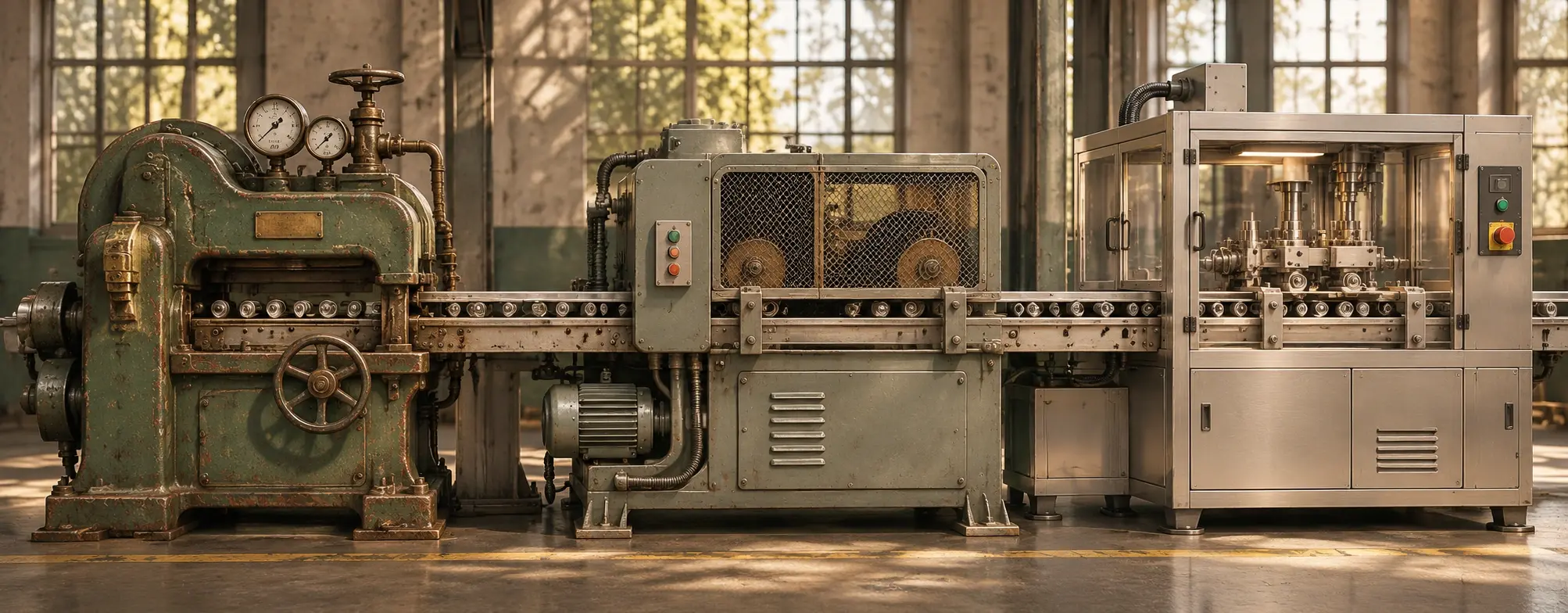
Greenfield plants may start with better-connected data, but enterprise AI still has to work across the brownfield factories that manufacturers already operate.
Manufacturers are getting better at proving what AI can do inside a factory. But making the same capability useful across an entire plant network is proving harder.
The Manufacturing Leadership Council’s 2026 Smart Factories survey captures the tension. Twenty-nine percent of respondents said they were scaling smart-factory practices across their full factory footprint. At the same time, 47% identified legacy equipment as a primary obstacle to their smart-factory strategy, while 37% cited a lack of data interoperability, up from 22% the previous year.
Current reshoring and domestic manufacturing investment are adding another layer to that unevenness. In the Reshoring Initiative’s 2026 survey, 36% of OEM respondents said they had reshored or were actively undertaking additional reshoring, while 63% planned U.S. capital investment during 2026 or 2027. New capacity can therefore be coming online alongside long-established plants that still depend on very different generations of equipment and systems. Manufacturers may be expanding their physical footprint at the same time they are trying to create a more consistent digital one, and new capacity does not automatically arrive AI-ready.
Those numbers point to a problem that can be obscured by individual smart-factory successes: one manufacturer can contain several different levels of digital maturity at once.
One company can contain very different data environments
Consider an illustrative manufacturer operating three plants.
|
Plant A |
Plant B |
Plant C |
|
|
Equipment |
Newer, connected machinery |
Mix of newer and legacy equipment |
Predominantly older equipment |
|
Production data |
Available continuously |
Spread across several systems |
Partial or periodically recorded |
|
Maintenance history |
Connected to equipment records |
Stored separately |
Combination of digital and manual records |
|
Data definitions |
Largely standardized |
Partially aligned |
Shaped by local systems and practices |
|
What an enterprise AI system can see |
Rich operational picture |
Incomplete picture |
Significant gaps |
Plant A might support an effective predictive-maintenance model using equipment condition, operating history, and maintenance records. The model can detect patterns associated with failure and give engineers earlier warning that intervention may be needed.
Moving the same capability to Plant B is already less straightforward. Some of the required information may exist, but not in the same systems or format. Plant C may have machinery that does not expose the same operating signals at all, while years of maintenance history have been recorded differently.
The model has crossed a factory boundary, and its underlying assumptions about the available data have crossed with it.
NIST’s 2026 roadmap for AI and machine learning in smart manufacturing identifies effective data management and integration with heterogeneous sensing and control systems among the critical challenges still facing industrial AI. The difficulty sits underneath the model: manufacturers need usable information from systems that were never designed to produce or exchange it in the same way.
A successful pilot proves less than it appears to
The scaling problem is visible even among some of the world’s most advanced factories.
The World Economic Forum’s Global Lighthouse Network has documented 223 leading manufacturing sites and more than 1,150 technology use cases. Yet a 2026 analysis found that only 23 Lighthouse organizations had extended their operational transformation across three or more sites.
Moving from one plant to another introduces different equipment, products, economics, workforce capabilities, and operating conditions. A use case designed around the strongest site can therefore carry dependencies that only become obvious when another factory tries to adopt it.
Predictive maintenance makes the problem easy to see. A model trained using vibration readings cannot use the same input at a plant where the relevant equipment has no vibration sensors. A maintenance event recorded consistently in one computerized maintenance system may have no direct equivalent in another plant’s records. Even familiar measures such as downtime can become difficult to compare when sites classify planned stops, faults, and changeovers differently.
Scaling therefore requires more than deploying the same software repeatedly. The receiving plant has to provide enough of the information and context that made the original use case viable.
The World Economic Forum describes this through a “floor-and-frontier” model. Selected plants can continue pushing into more advanced applications, while the wider network establishes enough common data access, metrics, skills, and governance for proven capabilities to travel.
For manufacturers, this distinction creates a more realistic target than trying to make every site equally sophisticated.
Older equipment can still be part of the picture
Brownfield factories are the normal condition of manufacturing rather than an exception. GSMA describes most factories as environments where modern equipment operates alongside machinery that may be decades old. The connectivity problem is therefore often one of extracting useful information from existing equipment without disrupting live production.
Replacement is only one possible response.
Industrial gateways can translate proprietary machine protocols into formats modern systems can use. Edge platforms can collect and process information close to the equipment. Additional sensing can expose conditions that the original machine was never built to report digitally. GSMA describes these approaches as ways of connecting existing operational technology with modern networking and software layers.
The potential is visible in brownfield deployments already operating at significant scale. ACG Packaging Materials in Shirwal, India, applied machine-learning models trained on more than two years of production data to equipment that was 60 years old. The World Economic Forum reports a 37% improvement in first-pass yield and a 43% reduction in quality setup time from the use case.
Age alone tells us surprisingly little about whether a manufacturing asset can participate in an AI-enabled operation. What is more important is whether the required operational information can be captured reliably and connected with enough context to support the intended decision.
In our three-plant example, Plant C may never resemble Plant A, and it may not need to.
What needs to be consistent across plants?
A manufacturer planning to scale predictive maintenance could start by identifying the information the use case genuinely depends on. Across plants, the AI may need to:
- Recognize the same asset reliably
- Understand whether it is running or stopped
- Associate faults with the correct equipment
- Access relevant maintenance history
- Interpret sensor measurements where those measurements are required by the model.
How each plant supplies that information can vary. One may expose it directly from connected machinery, while another may combine a plant historian with maintenance data from a separate system. An older facility may require an additional sensor or gateway around existing equipment.
The underlying technology can remain different while the information presented to the wider system becomes sufficiently consistent.
This is where interoperability becomes more than connectivity. Sending data from a machine into a platform does not guarantee that another system understands what the data represents. Asset identities, timestamps, units, event definitions, and relationships between production and maintenance records have to carry enough meaning for information from different plants to be interpreted together.
The increasing concern about interoperability in the Manufacturing Leadership Council survey is therefore particularly relevant to AI. Manufacturers are trying to move from isolated digital improvements toward intelligence that can operate across wider portions of the business, while the data underneath those operations still reflects years of local technology decisions.
One connected plant does not give AI an enterprise view
New facilities and selective modernization can make differences across a manufacturing network more visible. A greenfield plant may begin with better connectivity and more consistent data practices, while another site continues operating machinery and systems acquired over several decades.
The objective does not have to be technological uniformity.
A useful enterprise foundation allows plants with different technology histories to expose the information required by the use cases the manufacturer wants to scale. Some sites may need deeper modernization. Others may need targeted integration around equipment that remains perfectly capable of doing its primary job.
The test for manufacturing AI eventually moves beyond whether a model works in the plant where it was developed. It has to work with enough of the real manufacturing estate to support the decisions the enterprise expects it to make.
A manufacturer can have an excellent AI system and still have an incomplete operational picture. Scaling depends on bringing more of that picture into view.
Continue Exploring
Fulcrum Digital works with manufacturers across data modernization, enterprise integration, and environments where legacy and modern platforms need to continue operating together. We help connect plant and enterprise systems, improve access to operational data, and sequence modernization around the realities of live production rather than assuming the factory can be rebuilt around new technology.