Quick Answer
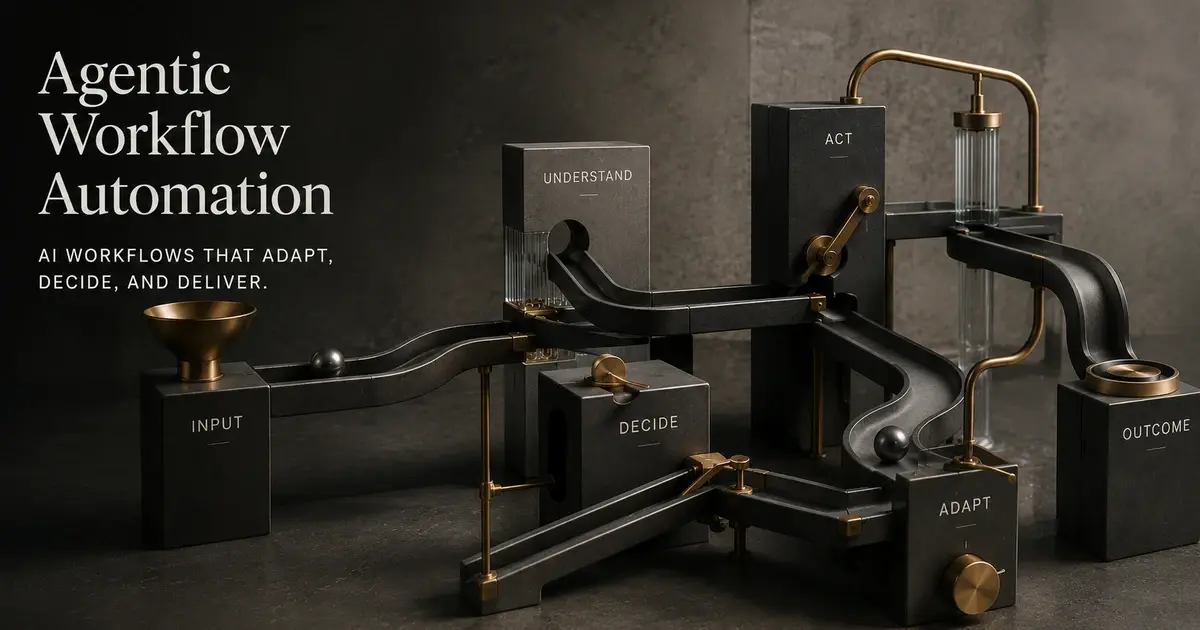
Agentic workflow automation uses AI agents to carry out multi-step business processes that require judgment, adaptation, tool use, and exception handling. Unlike fixed workflow automation, it allows agents to decide what action to take next based on the task, available data, operating rules, and changing conditions.
It is best suited to processes that cannot be fully reduced to rigid rules, including document-heavy operations, investigations, service workflows, claims handling, software delivery, and other work where the path changes as new information appears.
What is agentic workflow automation?
Agentic workflow automation is a form of process automation in which AI agents plan, execute, and coordinate work across a business workflow. The agents can interpret inputs, use enterprise tools, retrieve information, make bounded decisions, and escalate cases that require human judgment.
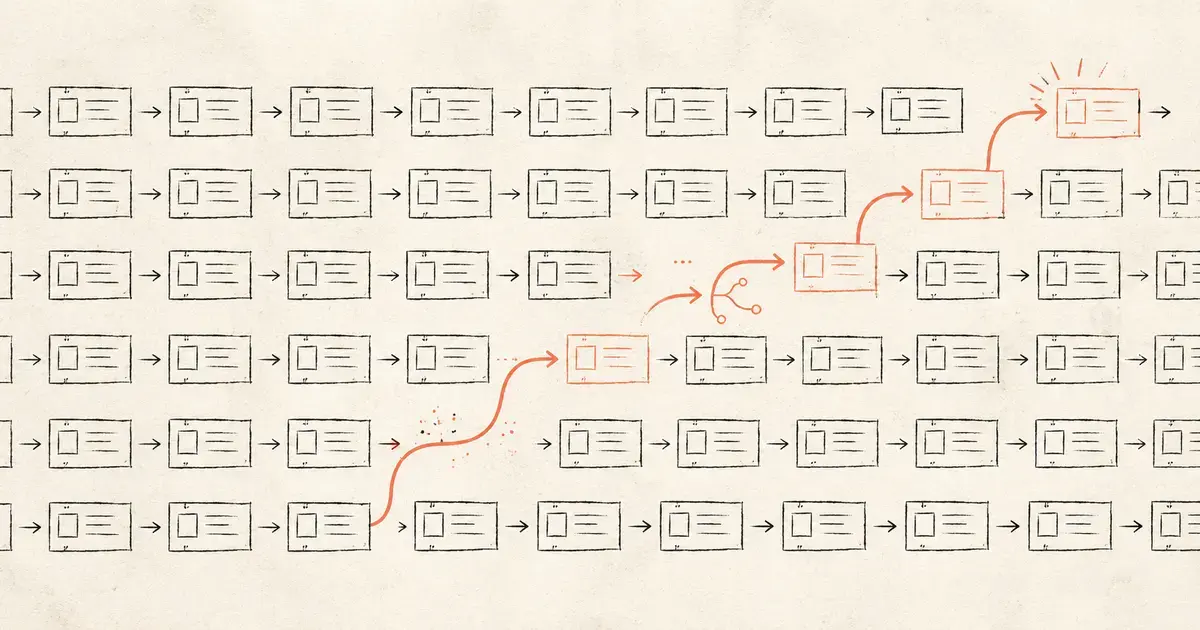
Traditional workflow automation follows a predefined sequence: when one event occurs, the system triggers the next configured step. That model works well when the process is stable and the rules are known in advance.
Agentic AI workflow automation is designed for work with greater variation. An agent may need to examine a document, determine what information is missing, query another system, select an appropriate action, and revise its approach when the first attempt does not resolve the task.
An enterprise implementation may use one agent or several specialized agents. The workflow still operates within defined permissions, policies, and review points; autonomy determines how work progresses inside those boundaries.
For the broader enterprise context surrounding architecture, deployment, governance, and readiness, see The Enterprise Guide to Agentic AI.
How is agentic workflow automation different from traditional automation?
Traditional automation executes predefined instructions, while agentic workflow automation can determine how to complete a task within established constraints. The difference lies in decision-making, adaptability, and the ability to manage work that does not follow one predictable path.
Conventional workflow automation is effective for repetitive processes with clear triggers, rules, and outcomes. A system might move an approved invoice to payment, send a notification after a status change, or route a form based on a field value.
Agentic workflow automation can handle ambiguity within a controlled scope. An AI agent may compare evidence from several sources, choose which system to query, decide whether confidence is sufficient to proceed, and ask for human review when the case falls outside policy.
The distinction is especially important in enterprise processes containing:
- Unstructured documents or natural-language requests
- Missing, conflicting, or changing information
- Decisions that depend on context
- Multiple tools and data sources
- Exceptions that cannot be predicted in advance
- Tasks requiring investigation before execution
The comparison is explored in greater depth in Agentic AI vs Traditional Automation: What’s the Real Difference? which examines where deterministic workflows remain the better choice and where agentic behavior adds genuine value.
How do enterprises design an agentic workflow?
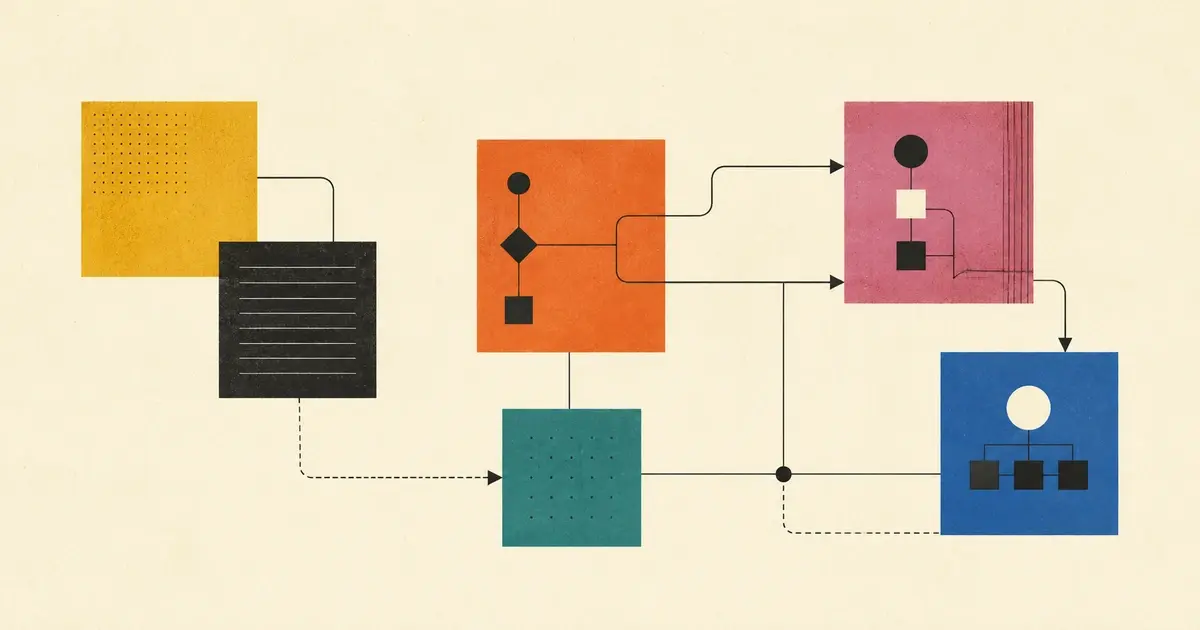
An enterprise agentic workflow begins with a defined business outcome, clear operating boundaries, and an explicit division of responsibility between AI agents, software systems, and people. The design must specify what agents may decide, which tools they may use, and when work must be reviewed or escalated.
A strong agentic workflow design usually covers six elements:
- Objective: The result the workflow is expected to produce
- Context: The data, documents, history, and policies agents may use
- Roles: The responsibilities assigned to each agent or system
- Tools: The applications, APIs, databases, and services agents may access
- Controls: Permissions, approval rules, confidence thresholds, and audit requirements
- Exceptions: Conditions that trigger retries, alternative routes, or human intervention
An AI orchestration platform can coordinate these components by routing tasks, maintaining workflow state, managing agent interactions, and selecting the appropriate model or tool for each stage. In larger environments, an enterprise agentic AI platform may also provide governance, observability, security, and reusable services across multiple workflows.
Human review should be designed into the workflow wherever the consequences of error are material. Approval gates, escalation rules, and confidence thresholds give organizations a practical way to use agentic decision-making without allowing automation to outrun accountability.
Why does enterprise agentic AI workflow automation stall?
Agentic workflow automation usually stalls when organizations automate a process before defining its ownership, boundaries, exception paths, or production controls. The most common failures are operational and architectural, rather than failures of the underlying model.
Typical causes include:
-
An unclear business outcome
-
Too much autonomy assigned too early
-
Poor access to reliable enterprise data
-
Weak integration with existing systems
-
No owner for exceptions or escalations
-
Inadequate monitoring after deployment
-
Prompts or policies that change without governance
-
No method for measuring business performance
A workflow may look successful during a controlled demonstration because the inputs are clean and the task path is narrow. Production environments expose the harder conditions: incomplete records, unavailable tools, conflicting instructions, edge cases, policy restrictions, and users who phrase the same request in dozens of ways.
Organizations also underestimate the exception load. When every unusual case is passed to a human without prioritization or context, the workflow merely relocates the bottleneck.
Why Enterprise Agentic AI Workflow Automation Stalls and What Fixes It examines these failure points in more detail, including exception handling, prompt handoffs, stalled decisions, and the controls needed to move from pilot performance to dependable operations.
Where is agentic workflow automation used in enterprises?
Agentic workflow automation is most valuable in processes that combine repetitive work with interpretation, investigation, and judgment. It is already being applied across insurance, financial services, commerce, customer operations, software engineering, and enterprise knowledge workflows.
In insurance, agents can review claim documents, identify missing evidence, compare information against policy conditions, and route complex cases to an adjuster. In banking and financial services, they can support onboarding, compliance reviews, transaction investigations, and service requests that span several systems.
Commerce and supply chain teams can use agentic workflows to analyze demand changes, investigate stock issues, coordinate replenishment decisions, and respond to operational disruptions. Customer operations teams can combine knowledge retrieval, account data, and workflow execution to resolve requests that would otherwise move between several departments.
In software delivery, specialized agents can assist with requirements analysis, code generation, testing, documentation, and release preparation while preserving approval points for engineering teams.
Document-heavy enterprise processes are another strong fit. An agent can interpret incoming material, retrieve relevant knowledge, determine the next step, and update downstream systems without requiring a person to manually move information between each stage.
What foundation does agentic workflow automation require?
Production-grade agentic workflow automation requires more than an AI model and a set of prompts. It depends on a governed platform foundation that can control access, coordinate agents, preserve context, monitor outcomes, and support workflows as their complexity grows.
-
That foundation should provide:
-
Secure connections to enterprise systems and data
-
Identity, permissions, and role-based access
-
Agent and workflow orchestration
-
Human approval and escalation mechanisms
-
Logging, traceability, and audit records
-
Performance and cost monitoring
-
Reusable tools, policies, and knowledge sources
FD RYZE®, Fulcrum Digital’s enterprise-scale AI platform, provides a layer for building and operating AI agents across governed workflows. It gives organizations the orchestration, knowledge, control, and engineering foundation required to move agentic workflows from isolated pilots into repeatable enterprise operations.
Continue Exploring
Agentic workflow automation works best when the use case is narrow enough to govern and valuable enough to justify a more adaptive operating model. The key decisions are where agents should act independently, where deterministic automation should remain in place, and where human judgment must stay in the loop.
If you are evaluating a process that repeatedly stalls at exceptions, handoffs, document review, or cross-system decisions, Fulcrum Digital can help assess whether agentic workflow automation is the right fit and what the production architecture would require.
Related Reading
For the broader enterprise view, read The Enterprise Guide to Agentic AI, covering the operating foundations, governance, architecture, and readiness considerations behind scalable agentic systems.
Related Questions
What is the difference between workflow automation and agentic AI workflow automation?
Workflow automation follows predefined rules and routes. Agentic AI workflow automation allows AI agents to determine how to complete a task within governed boundaries, making it better suited to processes involving ambiguity, judgment, and changing conditions.
When should an enterprise use agentic workflow automation?
Enterprises should consider it when a valuable process contains frequent exceptions, unstructured information, cross-system investigation, or decisions that cannot be reliably encoded as fixed rules. Stable, repetitive processes may still be better served by conventional automation.
Does agentic workflow automation require multiple AI agents?
No. A workflow may use one agent with access to several tools or multiple specialized agents with distinct responsibilities. The right design depends on task complexity, governance requirements, and whether responsibilities benefit from being separated.
What are examples of agentic AI workflow automation?
Examples include insurance claims review, compliance investigations, customer service resolution, document processing, supply chain exception management, software delivery workflows, and employee support processes that require information retrieval and action across several systems.
How much human oversight does an agentic workflow need?
The level of oversight should reflect the consequences of the task. High-risk decisions may require mandatory approval, while lower-risk actions can use confidence thresholds, sampled review, or escalation only when the agent encounters an exception.
Related Terms
Workflow Automation
Agent Orchestration
Multi-Agent Systems
Agentic Workflow Design
AI Orchestration Platform
Enterprise Agentic AI Platform
Human-in-the-Loop
Enterprise AI Monitoring
Prompt Governance