Climate volatility is reshaping catastrophe modeling, underwriting assumptions, and financial risk exposure
What this article covers:
- Historical climate data is no longer enough on its own.
- Wildfire and flood assumptions are shifting faster than model cycles.
- Secondary perils now carry primary-level financial consequences.
- Insurers are already responding through pricing, exits, and reinsurance changes.
- Banks inherit this risk through collateral, credit, and insurance availability.
- The real gap is turning better models into reliable production systems.
The foundational assumption inside every classical catastrophe model is that the past is a reliable guide to the future; that a flood recorded in 1980 carries the same statistical weight as one recorded in 2020; that a fire season from 1995 describes the same risk environment as one from today. Hydrologists and actuaries gave this assumption a name: stationarity.
For most of the twentieth century, it held well enough to be useful. It no longer does.
The financial consequences are already visible across insurance losses, carrier withdrawals, premium volatility, reinsurance pressure, and regional underwriting retrenchment. Classical CAT models were calibrated against historical observational records. When environmental baselines begin shifting faster than those records can adapt, the models start underestimating present-day risk.
The Evidence That Stationarity Has Already Failed
Ellicott City, Maryland remains one of the clearest examples. In July 2016, more than six inches of rain fell in three hours, producing catastrophic flash flooding that NOAA classified as a 1-in-1,000-year event. Less than two years later, nearly identical rainfall caused another destructive flood in the same location. Climate researchers later summarized the shift bluntly: “the whole distribution has shifted — what used to be a 100-year event becomes, say, a 10-year event.”
The same pattern is appearing across multiple climate perils. The Journal of Catastrophe Risk and Resilience wrote in 2023 that “the assumption of stationarity in the historical observations for many perils is untenable.”
For insurers and financial institutions, the implications extend beyond climate science. CAT models influence underwriting, capital allocation, pricing, reinsurance structures, property risk evaluation, and portfolio exposure assumptions. When the underlying distributions begin drifting, the operational consequences spread through those systems simultaneously.
Wildfire Seasons No Longer Match Historical Risk Windows
Wildfire season in the western United States has extended from roughly five months to more than seven months since the 1970s, according to USDA Climate Hubs. NASA research also shows seasons beginning earlier and extending later across large parts of the western US.
Most wildfire CAT models were calibrated against older seasonal distributions where peak activity concentrated within narrower historical windows. The problem becomes visible when destructive fire activity begins appearing outside those assumptions.
The January 2025 Los Angeles fires became the clearest financial example yet documented. The Palisades and Eaton fires ignited during what had historically been considered a lower-risk period for Southern California, driven by drought conditions and Santa Ana winds reaching 100 mph. Munich Re estimated total losses at approximately $53 billion, including roughly $40 billion in insured losses—the largest insured wildfire loss event globally.
Climate scientist Daniel Swain noted that California’s fire season has “already lengthened considerably in a warming climate,” increasing the overlap between critically dry vegetation and offshore wind conditions.
How the CAT Modeling Industry Is Responding
The stationarity problem is not invisible to catastrophe modelers. Verisk, AIR, and Moody’s RMS have all acknowledged the limitations of historical-only calibration approaches. Neuberger Berman’s Catastrophe Modeling 101 primer published in 2025 stated directly that CAT methodologies “are not well suited for less stationary perils such as wildfires.”
Regulatory adaptation has also accelerated. Under California Section 2644.4.5, which took effect January 2, 2025, insurers became permitted to use catastrophe models for wildfire ratemaking for the first time in state history. Verisk completed the California Department of Insurance review process in July 2025.
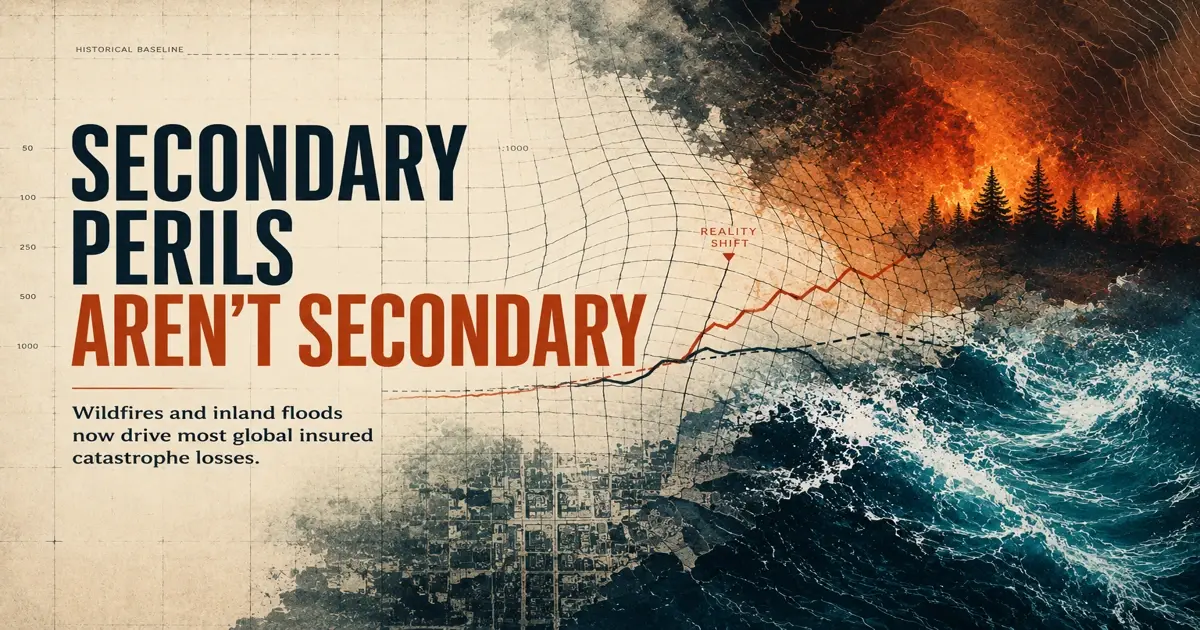
The broader industry classification framework is also under pressure. Wildfires, inland floods, and severe convective storms were historically categorized as “secondary perils.” Swiss Re’s 2025 sigma report found that secondary perils drove most of the $137 billion in global insured natural catastrophe losses during 2024. In the first half of 2025 alone, global insured losses reached $80 billion, with the Los Angeles wildfires accounting for approximately half that figure.
Wildfires now account for roughly 7% of insured natural catastrophe losses globally, up from approximately 1% a decade ago. The loss environment evolved faster than many classification and modeling assumptions surrounding it.
Stationarity Risk: What Changes for Financial Institutions
|
AREA |
OLD ASSUMPTION |
NEW PRESSURE |
|
Wildfire |
Seasonal risk windows were predictable |
Fire seasons are longer and less stable |
|
Flood |
Return periods held for decades |
Thresholds are shifting by region |
|
Secondary perils |
Smaller, manageable loss drivers |
Thresholds are shifting by region |
|
CAT models |
Historical data stayed reliable |
Climate baselines are moving faster |
|
Underwriting |
Risk could be reviewed periodically |
Exposure needs more frequent recalibration |
|
Banking exposure |
Insurance availability was assumed |
Coverage gaps now affect collateral risk |
What Changes in a Non-Stationary Environment
The adjustment is not simply “use more recent data.” The underlying assumptions themselves need to move continuously alongside changing environmental conditions.
Some catastrophe modelers are already conditioning wildfire projections against future climate scenarios rather than relying solely on historical baselines. Flood modeling research is also allowing exceedance thresholds to evolve alongside changing precipitation behavior rather than treating return periods as fixed constants.
Research from the mid-Atlantic region found that at more than 40% of long-term precipitation monitoring stations, the 100-year return interval had shifted significantly between 1950–1999 and 1950–2019. Researchers recommended updating extreme rainfall analyses on 20-year intervals, substantially faster than many current model update cycles.
The broader implication is operational: static assumptions degrade more quickly in systems where the underlying environment no longer behaves statically.
The Underwriting and Capital Consequences
The financial consequences are already showing up in carrier behavior. Over the past several years, standard carriers have non-renewed more than one million wildfire-exposed policies in California, pushing households and businesses toward residual market capacity.
US excess and surplus lines direct premiums reached $86.47 billion in 2023, representing 9.2% of total US direct premiums and continuing a multi-year growth trend as admitted carriers reduced exposure to increasingly volatile risk environments.
Swiss Re research also found that the number of severe convective storm events causing losses above $1 billion was 59% higher in the five years leading to 2025 than during the previous five-year period.
The protection gap continues expanding alongside insured losses. Of $318 billion in global economic losses from natural catastrophes during 2024, $181 billion (57%) remained uninsured.
For banks, the implications extend beyond insurance pricing. Commercial real estate exposure, collateral valuation, regional credit concentration, and insurance availability all inherit many of the same assumptions embedded inside catastrophe models. A property portfolio evaluated against outdated environmental assumptions carries risk that balance-sheet models may not yet fully capture.
The Institutions Already Moving
The institutional response is increasingly architectural rather than purely analytical.
Climate-conditioned models, satellite-based vegetation monitoring, probabilistic fire spread forecasting, and updated flood frequency analysis already exist. The larger challenge is operational integration: connecting those outputs into systems that institutions can govern, monitor, audit, and rely on continuously.
This is where implementation gaps still emerge most frequently. Across more than 4,500 production engagements since 1999, Fulcrum Digital has consistently seen similar failure patterns inside financial services and insurance environments: data infrastructure that performs well during development but weakens under live conditions, AI operations capability excluded from original project scope, and governance frameworks designed for compliance review rather than operational decision-making.
Running a climate-risk model in a controlled environment and maintaining it as a dependable production system connected to live workflows are fundamentally different engineering disciplines.
The stationarity assumption held when environmental baselines moved slowly enough for historical records to remain dependable over long periods. Financial institutions now face a different environment. One where the assumptions underneath catastrophe modeling systems may change faster than traditional operational cycles were designed to absorb.
Read the full whitepaper
This article focuses on one failure point: stationarity. The full Fulcrum Digital whitepaper examines the broader architecture financial institutions need as climate disruption becomes an operational systems challenge, from predictive intelligence infrastructure and catastrophe modeling to regulatory pressure, quantum methods, and response integration.
Download Climate Disruption, Predictive Intelligence, and the Architecture of Operational Survival in Financial Services.
Frequently Asked Questions
What is stationarity in catastrophe modeling and how does climate change affect catastrophe (CAT) model accuracy?
Stationarity is the assumption that historical climate patterns remain statistically reliable over time. CAT models built on this assumption treat past flood, wildfire, or storm behavior as representative of future risk conditions. Climate change alters the frequency, timing, and severity of extreme events. When those changes outpace historical calibration data, catastrophe models can begin underestimating present-day exposure.
What are non-stationary catastrophe models?
Non-stationary models allow risk assumptions to evolve alongside changing environmental conditions. They incorporate updated climate signals, revised thresholds, and more frequent recalibration cycles rather than relying solely on long-term historical averages.
Why are insurers reassessing wildfire and flood risk models?
Wildfire seasons, rainfall intensity, and severe weather behavior are changing faster than many historical models were designed to accommodate. Insurers are reassessing models because historical return periods and seasonal assumptions are becoming less reliable in some regions.
Why are secondary perils becoming more important for insurers?
Wildfires, inland floods, and severe convective storms are producing larger and more frequent insured losses than many historical classifications anticipated. Swiss Re reported that secondary perils drove most global insured catastrophe losses during 2024.
Why does the stationarity problem matter for banks as well as insurers?
Banks inherit many of the same physical-risk assumptions through commercial real estate exposure, collateral valuation, regional lending concentration, and insurance availability across vulnerable markets.
How does Fulcrum Digital support predictive climate-risk infrastructure?
Fulcrum Digital focuses on the production engineering layer connecting predictive systems to operational environments. That includes governed data infrastructure, AI operations, auditability, and integration with institutional workflows that need to function under live conditions.