Compare FedNow vs ACH in 2026 across speed, availability, payment types, limits, reach, and fees to see where each payment rail fits.
The FedNow® Service and the ACH Network are two ways U.S. financial institutions move money between bank accounts, but they serve different payment needs. ACH has long supported payroll, bill payments, recurring debits, vendor payments, and other high-volume transfers. FedNow, launched by the Federal Reserve in 2023, introduced an always-available real-time payment rail that allows participating banks and credit unions to clear and settle credit transfers within seconds.
FedNow has now moved well beyond its launch phase. More than 1,800 financial institutions participate in the service, and it settled almost 5 million customer credit transfers in Q2 2026 alone. ACH remains far larger: the network processed 9.3 billion payments during the same quarter.
For financial institutions and businesses choosing between them, speed is only part of the decision. The payment type, timing requirement, receiving institution, transaction value, operating model, and cost can all influence which rail makes sense for a particular flow.
The comparison below covers the main differences, then looks at what each one means when choosing how a payment should move.
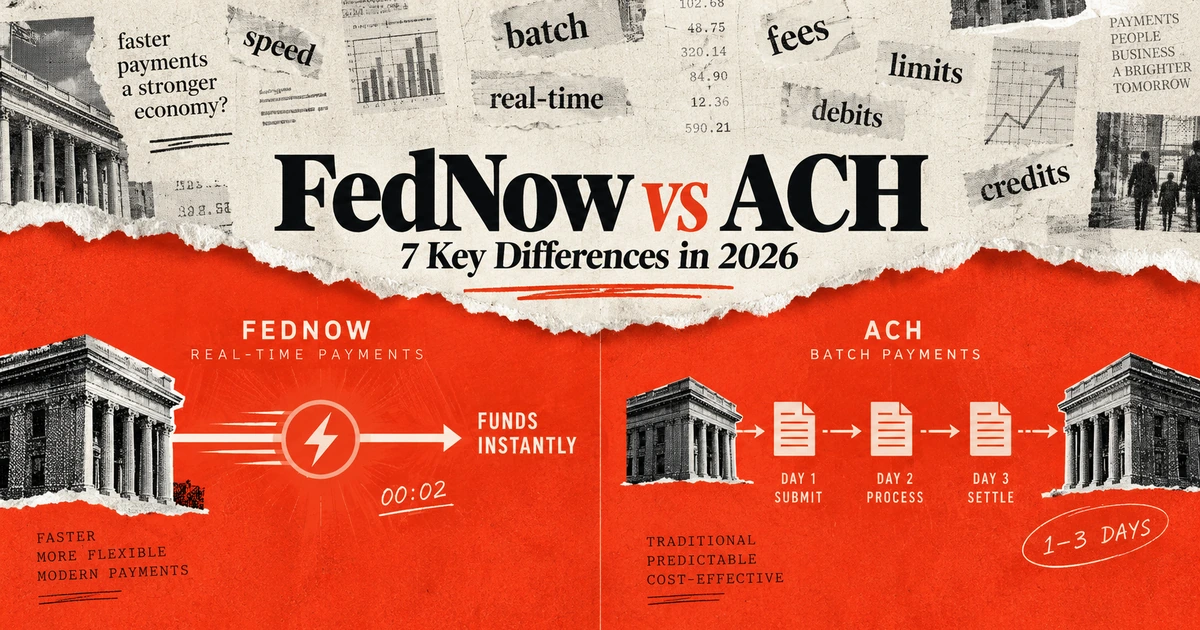
FedNow vs ACH at a glance
| FedNow | ACH | |
| Processing | Individual transactions settle in real time | Transactions are processed in batches |
| Availability | 24/7/365 | Scheduled processing; settlement windows apply |
| Speed | Typically seconds | Same business day or later, depending on service |
| Payment type | Credit transfers | Credits and debits |
| Settlement | Immediate interbank settlement | Settlement occurs through scheduled ACH windows |
| Current same-day limit | $10 million network limit | $1 million for Same Day ACH until Sept. 17, 2027 |
| Reach | More than 1,800 participating financial institutions | All U.S. bank and credit union accounts |
| Typical fit | Time-sensitive payments requiring immediate settlement | Payroll, recurring debits, collections, scheduled and high-volume payments |
1. FedNow settles in seconds. ACH works through processing windows.
FedNow handles customer credit transfers individually as they arrive. Once the sending and receiving institutions complete the transaction, settlement occurs within seconds and the recipient can receive the funds immediately.
ACH groups transactions for processing. Standard ACH payments may settle on a later banking day, while Same Day ACH speeds that process up through several settlement windows during the day. It is therefore useful to separate ACH from Same Day ACH when comparing payment speed; describing ACH simply as a multi-day system misses an important part of the network today.
For a business sending payroll on a planned schedule, settlement within the business day may be entirely adequate. A bank supporting an insurance payout, emergency disbursement, urgent supplier payment, or another transaction where the recipient needs the money immediately has a stronger case for FedNow.
The choice starts with how much the payment loses by waiting for the next available processing window.
2. FedNow keeps operating after the banking day ends.
FedNow runs continuously, including nights, weekends, and federal holidays. A payment initiated late on Saturday can still be cleared and settled without waiting for Monday. ACH operates around scheduled processing cycles. Same Day ACH has substantially shortened the wait, but a payment still needs to meet the appropriate submission window and banking-day requirements.
That difference changes more than customer convenience. A financial institution offering instant payments has to be prepared for payment activity outside traditional operating hours. Fraud monitoring, exception handling, liquidity management, customer notifications, and system availability may all need to support the same 24/7 schedule as the rail.
Businesses do not necessarily need that level of availability for every payment. Scheduled payroll or predictable vendor runs can continue to fit ACH well. Urgent disbursements and customer-facing payment experiences are more sensitive to a rail going offline with the business day.
3. ACH can pull money from an account. FedNow sends it from the payer.
ACH supports both credits and debits. An ACH credit starts with the payer: an employer sending payroll is a familiar example. An ACH debit starts with an authorized request to collect money from the payer’s account, which is why ACH is widely used for utility bills, mortgage payments, subscriptions, insurance premiums, and other recurring collections.
FedNow customer payments use a credit-push model. The person or business sending the money authorizes the transfer from their account. FedNow also supports Request for Payment messages, which allow a payee to ask for money, but the payer still has to approve the resulting credit transfer.
For businesses that regularly collect authorized payments from customers, ACH debit capability remains a significant advantage. FedNow fits flows where the payer can actively initiate or approve the payment and immediate delivery adds value.
That difference alone is enough to keep both rails relevant for many organizations.
4. The two networks handle finality and returns differently.
Payment finality can become confusing quickly, especially when FedNow is described as “irreversible” and ACH as “reversible.”
FedNow settles funds between participating institutions immediately. Under the Federal Reserve rules governing the service, that interbank settlement is final once completed. There are still mechanisms for returning funds and requesting a return when a payment was sent incorrectly or another problem occurs. A completed FedNow transaction therefore does not mean there is no process for addressing an error; it means the original settlement is not simply unwound as though it never happened. FedNow’s own 2026 fee schedule includes a specific transaction type for customer credit-transfer returns.
ACH has a more established set of return rules. Depending on the transaction and reason, a receiving bank may return an ACH entry for issues such as insufficient funds, an invalid account, or an unauthorized debit. Nacha—the organization that administers the ACH Network’s operating rules—sets the relevant procedures and deadlines.
For banks and businesses, that affects fraud controls, exception handling, customer-service processes, and how much review needs to happen before the payment is released.
5. FedNow currently allows larger same-day payments.
The FedNow network limit increased from $1 million to $10 million per customer credit transfer in November 2025. Individual banks and credit unions can still impose lower limits for their own customers.
Same Day ACH currently carries a $1 million per-payment limit. Nacha has approved an increase to $10 million beginning September 17, 2027, covering eligible consumer and business credits and debits across all three Same Day ACH settlement windows.
For most consumer payments, the difference may never come into play. It becomes more relevant for larger corporate disbursements, insurance claims, tax payments, merchant settlement, payroll funding, and treasury movements.
The gap is also temporary. Once Same Day ACH reaches $10 million, transaction size will become less useful as a deciding factor between the two rails, leaving speed, availability, payment direction, reach, and economics to carry more weight.
6. ACH reaches every U.S. bank account. FedNow is still expanding.
The ACH Network can reach all U.S. bank and credit union accounts, which gives businesses and financial institutions a very broad base for payroll, collections, B2B transactions, and consumer payments. Nacha reported 35.2 billion ACH payments worth $93 trillion in 2025.
FedNow requires the relevant financial institution to participate in the service. More than 1,800 institutions are now live, so its reach has grown considerably since its 2023 launch, but participation is not yet universal.
A bank or payment provider therefore cannot choose FedNow on speed alone. It also needs to know whether the receiving institution can accept the payment through that rail. Where instant reach is unavailable, ACH or another payment network may still be required.
For organizations supporting several payment methods, recipient reach becomes one input into routing the transaction to the appropriate rail rather than a reason to commit every payment to a single network.
7. ACH has lower network fees, but customer pricing is a separate question.
Federal Reserve operator fees show a sizable difference between the two services. In 2026, originating a FedNow customer credit transfer carries a $0.045 per-item fee, although the Federal Reserve is offsetting that charge for the first 2,500 qualifying transfers each month during 2026.
FedACH’s base origination fee is much lower, with an additional surcharge for Same Day ACH processing.
Those figures should not be mistaken for the price a business will necessarily see on its bank statement. Financial institutions, processors, and fintech platforms decide how they package and price payment services for customers. A business may pay different amounts depending on its provider, volume, account agreement, and the service being used.
For high-volume scheduled payments, ACH’s economics can remain attractive. When immediate settlement avoids a costly delay, supports a higher-value customer experience, or solves a time-sensitive business problem, the higher network cost of an instant payment can be easier to justify.
What changes inside a bank when payments run 24/7
Connecting to FedNow gives a financial institution access to an instant rail. Delivering an instant-payment service also depends on what happens before and after that rail.
Posting and reconciliation: A payment that settles within seconds still has to move through the bank’s internal systems. Core posting and reconciliation need to keep records current enough that the customer balance, ledger position, and transaction history reflect what has already settled. If those processes continue to run mainly in overnight batches, the network may finish its work long before the bank does.
Fraud controls: Fraud controls also have less time to intervene. ACH workflows can benefit from established return processes and batch-oriented review. An instant credit transfer moves quickly toward final settlement, so identity checks, transaction monitoring, account controls, and other pre-payment safeguards carry more responsibility before release.
Liquidity and operations: Continuous settlement also changes liquidity and operations. Banks may receive and send payments outside the hours when treasury and support teams traditionally managed daily positions. Internal visibility has to extend into those periods so teams know what has settled and whether additional liquidity or intervention is required.
Multi-rail routing: Most institutions are managing several rails at once. ACH, Same Day ACH, FedNow, wires, and other payment networks can serve different transaction profiles. Modern payment architecture increasingly needs enough integration and routing logic to choose among them without creating a separate operational stack for every rail.
The underlying systems work is familiar across banking and financial services: core integration, payment data, controls, reconciliation, and modernization all have to support the service the institution is promising to customers.
Choosing between FedNow and ACH
Most payment programs will not end with one rail replacing the other. ACH still covers an enormous range of scheduled, recurring, debit, and high-volume payments. FedNow adds a useful option where funds need to arrive immediately and both financial institutions can support the transaction.
The right decision can therefore vary by payment flow inside the same organization. A bank may keep payroll and recurring collections on ACH while using FedNow for urgent disbursements or customer transfers that benefit from immediate confirmation.
As payment options expand, the larger architecture question is how reliably an institution can connect those rails to its existing core, data, fraud, reconciliation, and treasury environment.
Further reading
ISO 20022 Migration: 5 Critical Roadblocks and How Banks Can Overcome Them
Modern payment rails increasingly rely on richer, structured transaction data. This article looks at the system, data, integration, and operating issues banks encounter as ISO 20022 moves from a messaging requirement into day-to-day payment processing.
Frequently Asked Questions
Is FedNow replacing ACH?
No. ACH continues to process enormous payment volumes and supports capabilities such as debit pulls that FedNow does not provide. FedNow adds an instant, always-available credit-transfer option. Many banks and payment providers can support both rails and use them for different transaction types.
FedNow vs Same Day ACH: what is the difference?
FedNow settles individual credit transfers within seconds and operates 24/7/365. Same Day ACH remains batch-based and uses three settlement windows during the processing day. It supports both credits and debits, while FedNow customer payments are credit transfers.
Can a FedNow payment be reversed?
FedNow interbank settlement is final once completed, but that does not mean every error or dispute has no remedy. The service supports payment returns and return-request processes. Whether funds are returned depends on the applicable circumstances and procedures.
Can consumers use FedNow directly?
No. FedNow is infrastructure provided to eligible financial institutions. Consumers and businesses access FedNow-enabled payments through participating banks, credit unions, and service providers rather than through a Federal Reserve consumer app.
Which is cheaper, FedNow or ACH?
At the Federal Reserve operator level, ACH currently carries lower per-item fees than FedNow. Customer pricing can differ substantially because banks and payment providers decide what they charge businesses or consumers. Speed, payment type, and operational requirements should therefore be considered alongside the network fee.