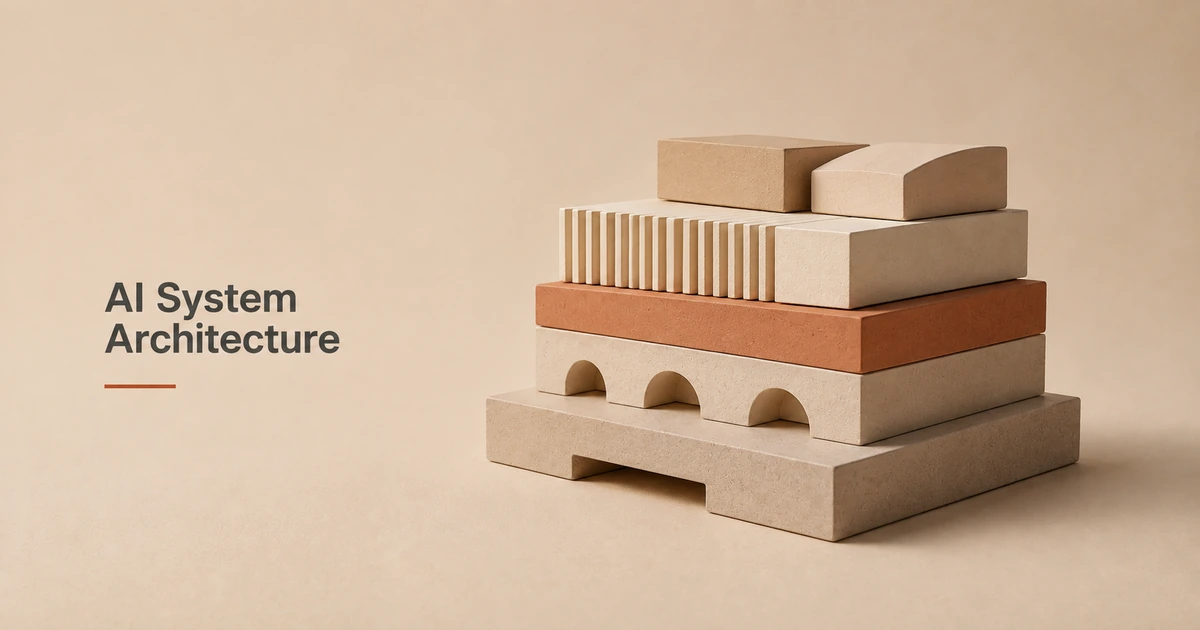
AI system architecture defines how data, models, integrations, infrastructure, and controls work together. Learn its key components and design principles.
Quick Answer
AI system architecture is the technical structure that defines how the components of an AI system work together. It covers how data enters and moves through the system, where models are used, how applications and enterprise systems connect, where the system runs, and how its behavior is monitored and controlled.
An AI model is only one part of this structure. A working AI system may also depend on data sources, retrieval mechanisms, APIs, applications, infrastructure, security controls, monitoring, and human review. The exact architecture changes according to what the system needs to do and the environment in which it operates.
What is AI system architecture?
AI system architecture describes how the parts of an individual AI system are organized, connected, and operated as one working environment. It turns a model or AI capability into a system that can receive information, process it, interact with other technology, produce or execute an outcome, and continue working reliably after deployment.
It sits within the broader discipline of AI architecture, which looks across the wider enterprise environment supporting AI. AI system architecture narrows the focus to a particular system and the components needed for that system to function.
For example, a document-processing system may need access to incoming files, extraction models, validation rules, human review, and downstream business applications. An enterprise assistant may need retrieval, model access, user permissions, APIs, and monitoring. The architecture maps how those parts connect rather than treating the AI model as a standalone capability.
A strong AI system design also accounts for dependencies between components. Changes to a data source, integration, model, or deployment environment can affect the wider system even when the other components remain unchanged.
What are the main components of an AI system architecture?
The main AI system architecture components usually include data and context, models, applications and integrations, execution or orchestration, infrastructure, and operational controls. Their exact form depends on the use case, but together they provide the environment in which the AI capability can work.
A typical enterprise AI system may include:
- Data and context: The information the system needs, including databases, documents, application data, knowledge sources, and other inputs. The quality and accessibility of this information can determine whether the system has enough reliable context to perform its task.
- Models and reasoning: The AI or machine learning models used to classify, predict, generate, retrieve, or reason over information. Some systems use one model, while others may route different tasks to different models.
- Applications and integrations: The interfaces that connect AI capabilities to users, applications, databases, workflows, and external systems. AI integration platforms can support these connections where AI needs to work across several parts of the enterprise environment.
- Execution and orchestration: The logic that determines how tasks move through the system, which components are used, and what happens when the system needs to call a tool, trigger a workflow, or coordinate several steps.
- Infrastructure and deployment: The compute, storage, networking, hosting, and deployment environment required to run the system. Depending on the use case, this may be cloud-based, on-premises, hybrid, or distributed across more than one environment.
- Monitoring, security, and controls: The mechanisms used to track system behavior, protect data and access, detect failures, manage changes, and keep the system within its intended operating limits.
Not every system needs the same level of complexity. A narrow predictive model embedded in one application may have a relatively simple architecture. A system that uses multiple data sources, models, tools, and business applications will require more components and stronger coordination between them.
How is AI system architecture different from AI architecture, AI solution architecture, and AI operational architecture?
These terms describe different levels of AI design. AI architecture provides the broader enterprise framework, AI system architecture defines the structure of an individual AI system, AI solution architecture applies that structure to a specific business solution, and AI operational architecture focuses on how the system is run and controlled after deployment.
| Term | Main focus |
| AI Architecture | The broader enterprise structure supporting AI across data, platforms, integration, governance, infrastructure, and operations. |
| AI system architecture | The components and connections that make an individual AI system work. |
| AI Solution Architecture | The design of an AI solution for a particular business problem, workflow, or use case. |
| AI Operational Architecture | The structures used to deploy, monitor, govern, maintain, and intervene in AI systems once they are operating. |
The boundaries can overlap because the same system may be viewed from several perspectives. A solution architect may decide how an AI capability should fit into a claims process, for example, while the system architecture defines the data sources, models, integrations, applications, and infrastructure required to make that solution work.
Keeping the terms distinct helps prevent one architecture document from trying to answer every design question at once. It also makes ownership clearer as an AI initiative moves from enterprise planning into system design, implementation, and production operations.
How does AI system architecture change for different types of AI?
AI system architecture changes according to what the AI needs to do. Predictive, generative, and agentic systems may share infrastructure and data foundations, but they often require different components because they process information, interact with users, and take action in different ways.
A predictive AI system may be built around data preparation, model training, inference, and a feedback process for evaluating performance over time.
A generative AI system may also need document retrieval, context management, model APIs, grounding, content controls, and mechanisms for managing the information sent to and returned by the model.
An agentic system may require additional capabilities for tool access, task coordination, state, permissions, and human review. When several agents need to work together, multi-agent systems introduce further requirements around how work is divided, shared, and coordinated.
The architecture should therefore follow the use case rather than a fixed template. Two AI systems built on the same model may require very different architectures if one only generates internal summaries while the other can retrieve customer information and initiate actions across business systems.
What makes an AI system architecture ready for production?
A production AI architecture needs reliable data, dependable integrations, appropriate infrastructure, security, monitoring, failure handling, and clear controls around how the system behaves. Production readiness depends on the whole system continuing to work under real operating conditions, not simply on whether the model performs well during testing.
Data is one of the first dependencies to examine. If the system relies on incomplete, outdated, inaccessible, or poorly structured information, weaknesses can appear downstream even when the model itself is functioning as expected. Data readiness helps determine whether the information feeding the system can support the intended use.
Integrations also need to remain dependable as applications, APIs, and upstream systems change. The architecture should account for what happens when a connection fails, a source becomes unavailable, or the system receives information it cannot process as expected.
The deployment environment must support the workload at the required level of performance and scale. This can involve decisions about compute, storage, networking, capacity, availability, and how system components are updated without disrupting the wider environment. These concerns increasingly sit within AI-native engineering as AI systems become part of normal software, platform, and infrastructure environments.
Production systems also need visibility after deployment. Enterprise AI monitoring helps teams track model behavior alongside infrastructure, workflows, integrations, failures, and other signals that can show when the wider system is no longer operating as expected.
Finally, governance & security need to be reflected in the architecture itself through permissions, data protection, auditability, review paths, and controls appropriate to what the system can access or do. These requirements become more important as AI moves from producing information to influencing decisions or taking actions inside live business processes.
Continue Exploring
Review Your AI System Architecture
An AI system can work well in testing and still encounter problems once it is connected to real data, applications, users, and production infrastructure. Reviewing the architecture early can expose weak integrations, missing controls, operational dependencies, and scaling issues before they become harder to correct.
CTA: Book a conversation
Related Reading
The Operational Architecture Behind Scalable Enterprise AI
This article looks beyond the individual model to the operating structures required when AI becomes part of live enterprise workflows. It covers orchestration, context, escalation, monitoring, drift, and other architectural concerns that become more important as systems grow in complexity.
Most Enterprise AI Systems Work… Until Production Starts.
An AI system that performs well in controlled testing can behave differently once it encounters live traffic, changing data, system dependencies, and operational pressure. This article examines why production problems often originate in the architecture surrounding the model and what needs to be considered before systems are expected to operate at scale.
Related Questions
Is AI system architecture the same as AI model architecture?
No. AI model architecture describes the internal structure of a particular model, while AI system architecture describes the wider technical environment in which that model is used. The system architecture may include data sources, applications, APIs, infrastructure, security, monitoring, and other components that allow the model to perform a useful function inside a larger system.
A single AI system can also use multiple models with different model architectures while keeping them within the same overall system design.
Does every AI system need the same architecture?
No. AI system architecture should reflect the system’s use case, data, integrations, risk, scale, performance requirements, and deployment environment. A system that classifies documents inside one application will have different requirements from an enterprise AI system that retrieves information from several sources and interacts with multiple business platforms.
The architecture can also change as the system grows or receives additional capabilities.
Does AI system architecture have to be cloud-based?
No. AI systems can run in cloud, on-premises, hybrid, or edge environments depending on their technical and business requirements. Factors such as data residency, latency, security, existing infrastructure, cost, and the systems an AI capability needs to access can all influence where different components are deployed.
Some architectures also distribute components across environments rather than running the entire system in one location.
What should an AI system architecture diagram show?
An AI system architecture diagram should show the major components of the system and how information, requests, and actions move between them. This commonly includes data sources, models, applications, integrations, infrastructure, external services, users, and important security or operational boundaries.
The level of detail should match the purpose of the diagram. A high-level diagram may show the main system relationships, while a technical diagram may include specific interfaces, deployment environments, data flows, and dependencies.
When should an AI system architecture be reviewed or changed?
AI system architecture should be reviewed when material changes are made to the system’s models, data sources, integrations, workloads, deployment environment, security requirements, or business use. Reviews are also useful when production monitoring reveals recurring failures, performance problems, rising costs, or dependencies that the original design did not adequately account for.
Architecture does not need to be redesigned every time one component changes, but significant changes should be assessed for their effect on the rest of the system.