Privacy & sovereignty ensure that personal and enterprise data complies with laws, ownership rights, and trust standards.
Privacy & sovereignty refer to the principles, policies, and technical controls that govern how personal data, sensitive information, and digital assets are stored, processed, and accessed, especially across national borders and jurisdictions. These concepts ensure that cloud-based and hybrid cloud systems comply with data protection laws, support risk management, and uphold customer trust by maintaining control over who owns, views, or uses the data.
Detailed Definition & Explanation
Privacy & sovereignty refer to the regulatory, technical, and strategic frameworks that determine how sensitive data is managed, accessed, and stored, particularly when data crosses borders or resides in cloud infrastructure. While privacy governs who has the right to access or use personal information, sovereignty refers to where that data physically or logically resides and which jurisdiction’s laws apply. Together, these principles are fundamental to maintaining customer trust, reducing exposure to data breaches, and ensuring compliance with a complex web of data protection laws, including the General Data Protection Regulation (GDPR) and emerging localization mandates.
The shift to cloud-based environments has intensified the importance of sovereignty. Enterprises now operate across multiple jurisdictions using public cloud, hybrid cloud, or sovereign cloud services that may store or process data in locations governed by conflicting legal regimes. This raises critical questions around access control, data governance, and regulatory jurisdiction. For example, storing personal data in a U.S.-based data center may conflict with EU privacy laws if no safeguards are in place. Similarly, many countries are implementing policies that require organizations to comply with localization regulations, ensuring that certain categories of sensitive information remain within national borders.
Key focus areas include:
- Data residency
- Jurisdictional control
- Regulatory compliance
- Access restrictions
- Data classification
FD Ryze enables enterprises to enforce data localization policies and route AI workflows through jurisdiction-compliant environments, making privacy and sovereignty built-in rather than bolted on.
Why It Matters
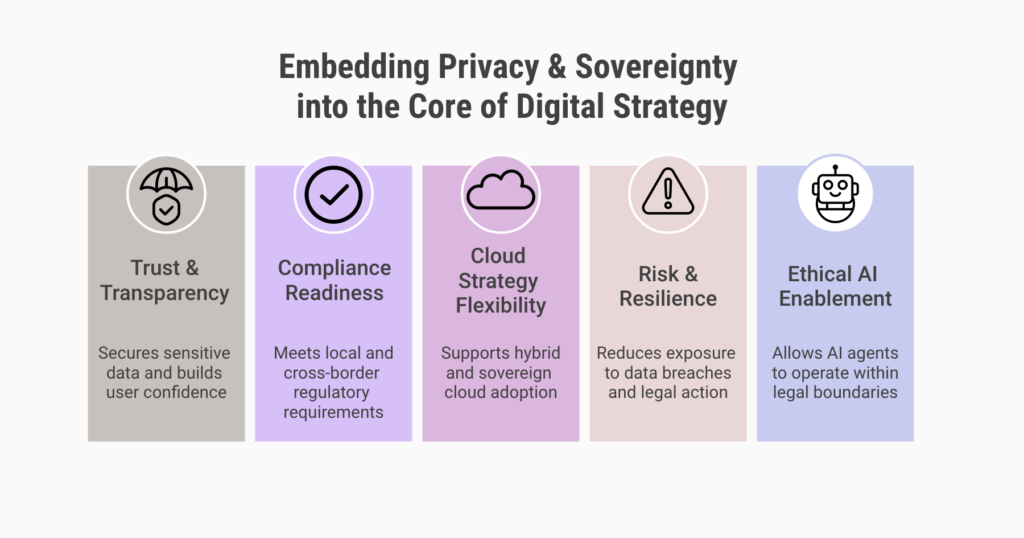
1. Protects Customer Trust in Data-Driven Environments
In an era of AI-powered personalization, customers expect their data to be handled with care, transparency, and consent. ECommerce and consumer products companies that store data in non-compliant jurisdictions risk losing customer trust, especially when high-profile breaches or violations of data protection laws come to light. Ensuring privacy and sovereignty allows enterprises to build digital experiences without compromising on ethical responsibility.
2. Reduces Legal and Regulatory Exposure
With the growing complexity of data sovereignty and regulatory requirements, non-compliance can result in fines, sanctions, or operational disruption. In financial services and insurance, where firms handle high volumes of personal information, aligning with local laws like the GDPR is critical to maintaining licenses and avoiding litigation. Proactively managing sovereignty reduces both regulatory and reputational risk.
3. Enables Cross-Border Cloud Strategy with Compliance
Organizations increasingly rely on cloud storage, hybrid cloud, and public cloud services to support scalability. For higher education institutions operating global campuses or student services, privacy and sovereignty frameworks ensure data can be securely shared or stored without violating jurisdictional boundaries. It also allows for more agile adoption of AI tools without compliance bottlenecks.
4. Strengthens Enterprise Risk Management and Resilience
Sovereignty-aligned architectures contribute directly to an organization’s risk management strategy by clarifying where data lives, who controls it, and how it’s recovered. In industries like insurance and CPS, sovereignty can determine whether AI agents or systems are even legally deployable in certain geographies. Built-in disaster recovery protocols also depend on knowing which jurisdiction governs backup and recovery sites.
5. Supports Ethical AI and Responsible Automation
Agentic AI systems often act on sensitive data in real time, making it essential that data governance and localization controls are embedded into the infrastructure. For sectors like financial services and eCommerce, this ensures agents operate within clear ethical and legal boundaries, reinforcing both automation outcomes and brand reputation.
Adoption Trends and Real-World Examples
As cloud-based systems become central to enterprise operations, data sovereignty and privacy have moved from legal checkboxes to strategic imperatives. According to IDC, 70% of Global 2000 enterprises will prioritize sovereign infrastructure by 2025 to strengthen compliance, security, and resilience. In Europe, the urgency is even more pronounced. Around 80% of organizations now identify digital sovereignty as a top priority in their cloud strategies. This growing focus is pushing enterprises to rethink how and where they store and process data, especially as AI systems take on more autonomous and jurisdiction-sensitive tasks.
Several leading platforms and providers are responding to this priority with sovereignty-aware solutions:
Google Cloud Sovereign Solutions
Google partners with national cloud providers across Europe and Asia to deliver sovereign cloud capabilities that help organizations meet regional data protection laws. These solutions support public sector workloads, financial institutions, and higher education platforms operating in regulated environments.
SAP Data Custodian
SAP’s data compliance platform offers transparency and control over cloud service operations, helping insurance and financial services organizations comply with regulatory requirements while using global cloud infrastructure.
Salesforce Hyperforce
Hyperforce enables customers to deploy Salesforce apps within specific geographic boundaries, ensuring that personal data and sensitive information remain compliant with local laws. This has made it a preferred choice for eCommerce and CPS brands operating across multiple markets.
What Lies Ahead
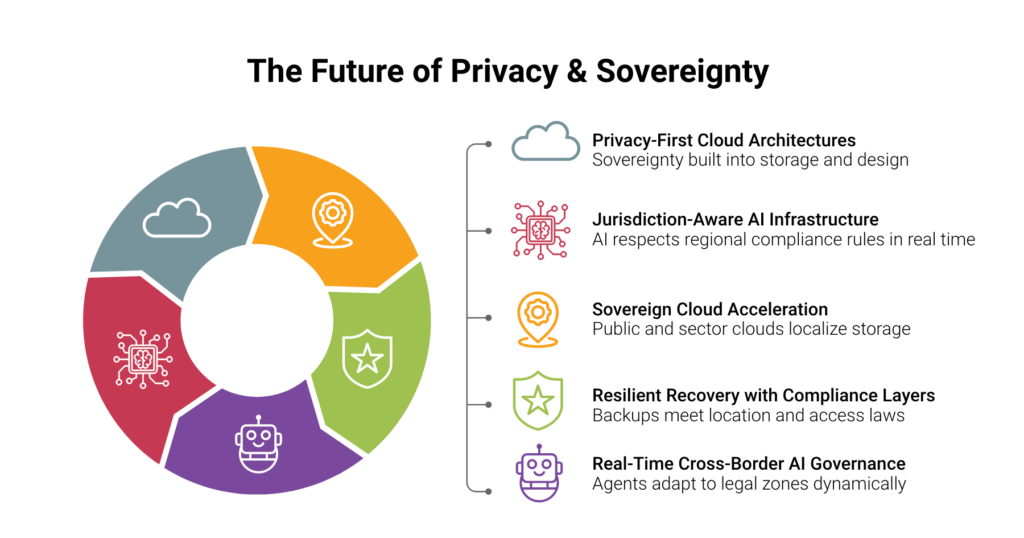
1. Privacy-First Cloud Architectures Will Become Standard
Cloud strategies will increasingly prioritize data localization, encryption at rest, and real-time access control as default features. Financial services and insurance organizations will lead this shift, embedding sovereignty into their infrastructure to meet both customer expectations and global regulatory requirements.
2. AI Governance Will Require Jurisdiction-Aware Infrastructure
As AI agents process personal data across borders, enterprises will need infrastructure that can enforce region-specific controls at runtime. ECommerce and consumer products firms deploying agentic systems for personalization or fulfillment must ensure those agents respect local data protection laws without compromising performance.
3. Sovereign Cloud Adoption Will Accelerate Globally
Driven by national data strategies and stricter compliance mandates, the use of sovereign cloud solutions will surge. Higher education and public sector-aligned CPS institutions will seek cloud providers that allow them to store and process data locally, ensuring resilience, sovereignty, and public trust.
4. Privacy & Sovereignty Will Extend to Backup and Disaster Recovery
Organizations will no longer focus sovereignty efforts only on primary systems. Disaster recovery environments will also need to meet regulatory requirements around data centers, storage jurisdictions, and access privileges. This will be especially critical in insurance and financial services, where recovery environments must be fully auditable.
5. Cross-Border AI Will Require Real-Time Compliance Logic
With AI agents making decisions across markets, sovereignty will become a dynamic design factor rather than a static policy. Enterprises in eCommerce and financial services will require AI platforms that can route decisions through jurisdictionally compliant logic in real time, balancing personalization with regulation at scale.
Related Terms
- Cloud Storage Compliance
- Digital Sovereignty
- Data Governance
- Hybrid Cloud Architecture
- Cloud Risk Management
- Access Control
- Sensitive Data Classification