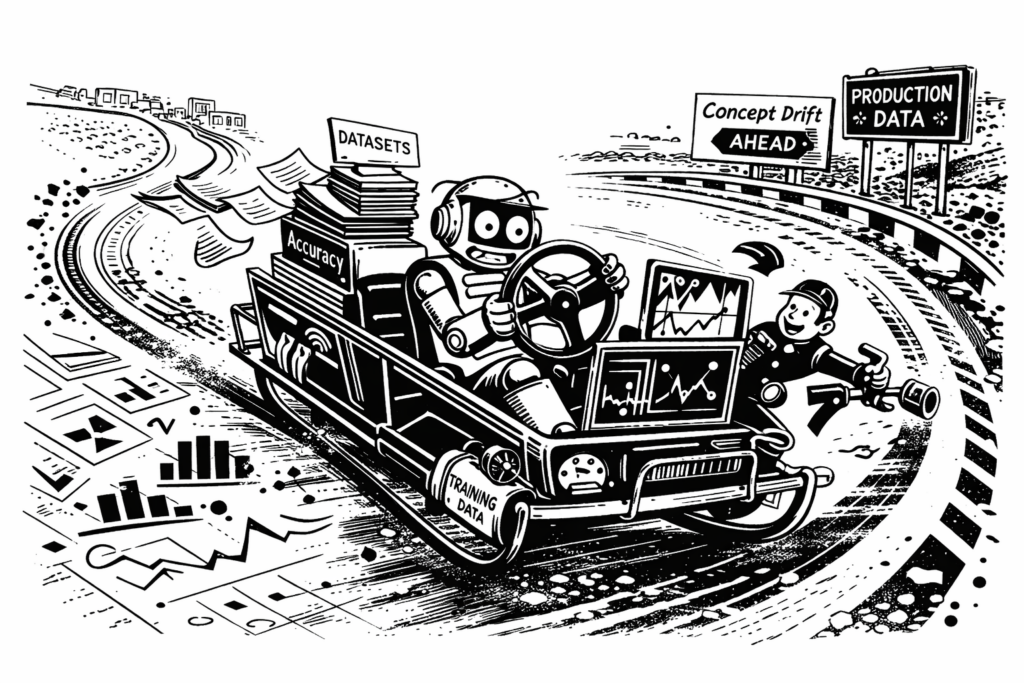
What employee pushback, stalled adoption, and shadow usage can reveal about the operational conditions underneath an AI rollout.
What this article covers:
- AI rejection often exposes organizational weakness before it exposes technical weakness.
- Failed rollouts usually point to broken workflows, bad data, and misaligned incentives.
- Employee resistance can be a more honest diagnostic than the business case behind the launch.
- Most AI initiatives stall because companies deploy tools before fixing operational reality.
- Treating rejection as feedback gives leaders a better path than relaunching the same mistake.
There’s a meeting happening right now in the boardroom somewhere. The slides say, “AI Transformation.” The deck is polished and the vendor has been paid. Six months from now, someone in that room will call the whole thing a failure, and they’ll blame the technology.
They’ll be wrong.
The pattern repeats across industries, but the reality is that the AI didn’t underperform. The organization hit it like a wall and called the wall a door. The resistance wasn’t irrational; it was the most accurate read of the situation anyone in the building had. Employees pushed back because they understood, intuitively, that layering a sophisticated tool on top of a broken system doesn’t fix the system. It just makes the chaos move faster.
Here’s what nobody wants to say out loud: when AI fails to embed inside a company, that failure is data. Expensive data, but data regardless.
The Statistic That Should Reframe This Conversation
Understanding why AI implementation fails in organizations starts with an uncomfortable number. According to MIT’s State of AI in Business research, 95% of enterprise AI initiatives deliver zero measurable ROI (CIO), what researchers now call the GenAI Divide. Most companies have moved past “should we invest in AI” and straight into “why isn’t it working.”
The standard industry response has been predictable: better change management, stronger executive sponsorship, more training sessions. When generative AI first gained traction, leaders raced to fund pilots, yet too many failed to scale or create measurable value, not because the technology was flawed, but because organizations lacked the scaffolding to bridge technical potential and business impact. (August)
The interesting question isn’t how to run a better rollout. It’s why the rollout keeps failing even when every box gets checked.
Google’s DORA team surveyed nearly 5,000 technology professionals and arrived at an answer that should reshape how every CXO thinks about this: AI functions as an amplifier. In high-performing organizations, it accelerates what is already working. In struggling ones, it magnifies what isn’t. A failed AI implementation doesn’t mean the organization chose the wrong tool. It means the organization surfaced exactly which processes, systems, and assumptions were already broken, and now has a choice about what to do with that information.
What AI Rejection Actually Looks Like
AI adoption failure in enterprises rarely looks like open revolt. Nobody stands up in an all-hands meeting and announces they’re rejecting the technology. What actually happens is subtle, and, on reflection, far more rational.
Employees demonstrate the tools in scheduled demos and ignore them the rest of the week. Shadow AI proliferates quietly: while only 40% of companies purchased an official AI subscription, workers from over 90% reported regular use of personal AI tools for work tasks (Lowtouch), an unmistakable signal that the official tools aren’t solving the actual problem. Middle managers approve pilots and then exclude the outputs from real decisions. Contact centers install summarization software running at high accuracy, and supervisors instruct agents to keep doing it by hand because the trust isn’t there.
Each of these is diagnostic information. Not about technology. About the organization.
Only 16% of organizations say their workflows are extremely well-documented, and 61% believe their AI strategy is only somewhat, or not at all, aligned with their operational capabilities. (Aiinnovationsunleashed) The AI didn’t create that misalignment, instead revealed it.
Five Things AI Rejection Is Actually Telling You
1. The processes were never real
AI is a ruthless test of whether a documented process exists or whether the company has just accumulated habits around specific people. Nearly half of organizations cite undocumented or ad-hoc processes as a consistent drag on efficiency. (Aiinnovationsunleashed) When AI can’t run a workflow, the assumption becomes that the AI failed. The more accurate diagnosis: that workflow was never designed. It was improvised.
2. The resistance lives higher up the org chart than leadership admits
Here’s a data point that tends to make rooms go quiet. Leaders and managers are more worried about losing their jobs to AI than frontline employees are (43% versus 36%). The people approving AI budgets are frequently the same people quietly ensuring the tools don’t disrupt their decision-making authority. This isn’t cynicism. It’s human nature.
3. The data never had to be trustworthy
Organizations often fail to link AI implementations to measurable outcomes and rarely conduct a detailed ROI analysis before deployment. (Fortune) When teams reject AI outputs as unreliable, they’re often right because the data feeding the model was already unreliable. Nobody had to confront this before because no system had ever demanded consistency at this scale. The AI didn’t create a data problem. It forced one into the open.
4. The strategy was built for the board deck, not the business
When AI is announced at the top and not resourced in the middle, employees read the signal accurately. Over half of organizations are not successfully implementing AI, with 21% admitting adoption is “mostly hype with limited progress.” (USDM) The rollout becomes theatre. And the people closest to the actual work the ones who can tell the difference between a genuine operational shift and a slide deck and then proceed to disengage accordingly.
5. The wrong problem is being solved
Approximately 70% of AI budget allocation flows toward the most visible business functions (Lowtouch), the ones that look good in a quarterly review. Back-office operations, where friction is highest and ROI is most consistent, get the remainder. Employees reject AI not because they fear change, but because the deployed tools don’t reduce their actual workload. The technology lands where it’s visible, not where it’s needed.
What to Do Instead of Relaunching
The instinct after an AI project failure is to re-run the play: new vendor, new training program, new rollout with better communication. That instinct is expensive and usually wrong.
The better move is to audit the rejection itself. Three questions do most of the work:
- Where did the AI fail to embed? That’s where the process is broken, not the technology.
- Who resisted most, and at what level? The answer is probably not where leadership assumed. Resistance concentrated in middle management usually signals incentive misalignment, not fear of change.
- What data did the AI surface as messy? That’s the infrastructure debt that was always there. The AI didn’t create it but made it impossible to ignore it any longer.
McKinsey data shows only 21% of companies have redesigned workflows to integrate AI effectively, and fewer than one-third follow recognized scaling practices like KPI tracking, governance road-mapping, or cross-functional change management, yet those that do report consistently stronger business impact. (CIO)
The difference isn’t better AI. It’s better organizational self-awareness before the deployment begins.
The Most Expensive Diagnostic a Company Will Ever Ignore
A failed AI implementation is not evidence that the technology didn’t work. It’s a detailed map of which processes, systems, and assumptions were already not working, handed to leadership at significant cost.
Most companies re-run the pilot. The ones that don’t treat the rejection as a map. They redesign the organization, not just the rollout. They ask what the resistance is trying to say before they decide how to respond to it.
That’s when AI starts to stick.
If AI resistance is showing up in your business, that signal is worth reading before another pilot gets funded. Fulcrum Digital’s AI assessment can help you identify what’s blocking trust, adoption, and operational fit.