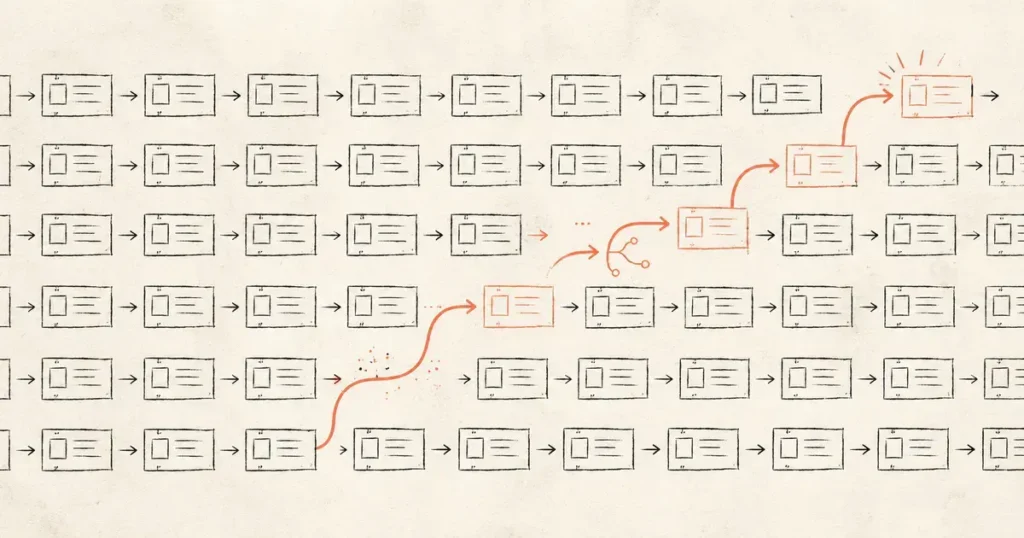

Enterprise agentic AI use cases are workflows in which AI agents pursue a defined business outcome across several steps, using company data, rules, and systems while escalating exceptions to people. In banking, that could mean assembling and validating a KYC case before it reaches compliance. In manufacturing, it could mean detecting a production constraint, checking material availability, and proposing a revised schedule for approval.
Enterprise buyers now need more than proof that an agent can retrieve information or generate an answer. They need to see where it can remove enough friction from a live process to justify the integration work, governance controls, and operational change around it. The value becomes easier to judge when the workflow is tied to a clear baseline and a result the business can measure after deployment.
Broad categories such as fraud detection, customer support, or demand forecasting are useful for identifying where AI may create value. For an investment decision, buyers need another level of detail: what happens after the prediction or recommendation, which systems the agent uses, what action follows, where human judgment remains, and how the outcome is recorded.
Before comparing individual use cases, it helps to establish what makes a workflow genuinely agentic. Prediction, retrieval, and generation may all contribute to the process, but the distinction depends on whether the system can pursue a defined goal across several steps while validating its work and staying within clear authority limits.
How to Distinguish a Real Agentic Use Case from Ordinary AI Automation
A use case becomes agentic when the system can pursue a defined business goal across several steps, use the tools and data required to move the work forward, and return control to people when a decision exceeds its authority. Extraction, prediction, or content generation may support the workflow, but none of them makes it agentic on its own.
Here are five questions that help clarify the difference.
| QUESTION TO ASK | WHAT TO LOOK FOR |
| Does the workflow have a defined goal? | A bounded outcome with a clear end state, such as preparing a complete loan file for underwriting rather than simply analyzing customer data. |
| Can it use the systems where the work happens? | Access to the relevant data, business rules, and enterprise tools needed to move the process forward. |
| Does it carry out multiple connected steps? | A sequence in which one result determines the next action, system call, or review path. |
| Can it validate its work and manage exceptions? | Checks for accuracy and completeness, with a defined response when information is missing, conflicting, or uncertain. |
| Are its decision rights and escalation points clear? | Explicit boundaries around what the system may complete, what requires approval, and when the workflow must stop. |
The Enterprise Guide to Agentic AI examines the architecture, governance, and operating model behind these workflows in greater depth. The 12 use cases below stay closer to the investment decision: the process involved, the manual work reduced, the business value available, the ROI metrics worth tracking, and the likely implementation complexity.
Agentic AI Use Cases in Banking and Financial Services
Banking workflows move through several checks before a customer can be onboarded, a loan can be reviewed, or a financial discrepancy can be cleared. Agentic AI is most relevant where information must be gathered from different systems, validated against established rules, and prepared for human action without weakening control.
1. KYC, Customer Onboarding, and Compliance Checks
An agentic onboarding workflow can read identity documents and forms, structure the submitted data, check whether required information is complete, and run configured background, sanctions, and anomaly checks. Compliance teams receive a more complete case, with missing information and potential concerns already surfaced for review.
- Reduces: Manual document extraction, repeated data entry, and first-pass completeness checks
- Business value: Shorter onboarding cycles and fewer avoidable errors can reduce the effort required per application while helping qualified customers complete onboarding sooner
- ROI metrics to track: Onboarding time, manual review hours per application, customer drop-off, data-error rate, and the percentage of applications completed without rework
- Implementation complexity: High, because the workflow handles sensitive identity data and must connect with existing KYC and compliance controls
2. Loan Origination and Pre-Underwriting
An agentic loan-origination workflow can gather information from applications, supporting documents, and connected data sources before assessing income and cash-flow details. It can pre-fill application fields, validate identity and submitted records, and assemble the findings into a structured summary. The lending decision remains with the underwriter; the workflow concentrates on preparing a complete, reviewable file.
- Reduces: Manual field population, repeated document checks, and fragmented pre-underwriting review
- Business value: Faster file preparation can increase the number of applications an underwriting team reviews within the same capacity while reducing delays caused by incomplete or inconsistent information
- ROI metrics to track: Application-to-review time, underwriter preparation time, file-completion rate, rework volume, and applications processed per reviewer
- Implementation complexity: High, due to the number of data connections, the sensitivity of customer information, and the audit requirements surrounding lending workflows
Financial Reconciliation and Exception Resolution
An agentic reconciliation workflow can compare disclosures, ledgers, statements, and other financial records to identify mismatches at both the text and data level. It can then assemble the relevant evidence and summarize the discrepancy for review, reducing the time analysts spend moving between documents and searching for the source of a difference.
- Reduces: Manual cross-checking, repetitive report review, and time spent locating supporting evidence
- Business value: Faster exception analysis can shorten reporting and reconciliation cycles while allowing finance teams to clear more discrepancies without increasing manual effort at the same rate
- ROI metrics to track: Reconciliation cycle time, analyst hours per exception, repeat discrepancies, resolution time, and the number of cases cleared within the reporting period
- Implementation complexity: Moderate, when the workflow remains focused on comparison and recommendation with human approval retained for resolution
Agentic AI Use Cases in Insurance
Insurance workflows depend on documents, policy rules, risk signals, and review paths that change with the type and complexity of each case. Agentic AI can help move work through those paths by preparing claims, assembling underwriting information, and surfacing compliance issues before a person makes the final decision.
4. Claims Intake, Validation, and Adjuster Preparation
An agentic claims workflow can extract information from claim documents and images, compare submitted details with policy and contract records, and flag missing or inconsistent data. It can also assess claim complexity and potential fraud indicators before assembling the findings for an adjuster.
- Reduces: Manual data extraction, repetitive claim checks, and time spent locating supporting information
- Business value: Better-prepared claim files can shorten handling time and allow adjusters to process more routine cases without increasing manual effort at the same rate
- ROI metrics to track: Adjuster hours per claim, claim cycle time, validation accuracy, rework rate, and the percentage of claims ready for review on first submission
- Implementation complexity: High, because the workflow connects claim records, policy information, external data sources, and human approval within a regulated process
5. Underwriting Submission Processing and Risk Assessment
An agentic underwriting workflow can extract and normalize information from submissions, validate required fields, and combine the resulting data with historical claims or other approved risk indicators. It can then prepare a structured risk summary, identify exceptions, and route the submission for underwriter review without making the final coverage or pricing decision.
- Reduces: Manual submission intake, repeated data checks, and time spent assembling information from disconnected sources
- Business value: More complete submission files can reduce underwriting preparation time and increase the number of risks reviewed within the same team capacity
- ROI metrics to track: Submission-to-review time, underwriter preparation hours, data-completion rate, rework volume, and submissions processed per underwriter
- Implementation complexity: High, because the workflow handles sensitive risk information and must remain aligned with underwriting rules, data permissions, and approval requirements
6. Policy and Regulatory Compliance Review
An agentic compliance workflow can review policy documents and endorsements against defined regulatory requirements, identify possible coverage gaps or non-compliant language, and prepare the supporting evidence for review. It can also maintain an audit trail of the checks performed and route unresolved issues to the relevant legal or compliance team.
- Reduces: Manual policy comparison, repetitive compliance checks, and time spent preparing audit evidence
- Business value: Faster review and clearer audit records can reduce compliance effort while helping teams address policy issues earlier in the review cycle
- ROI metrics to track: Policy review time, audit-preparation hours, exceptions identified, remediation time, and the percentage of reviews completed without additional evidence requests
- Implementation complexity: High, because the workflow depends on current regulatory rules, reliable document interpretation, and clearly defined escalation paths
Agentic AI Use Cases in Ecommerce
Ecommerce operations depend on accurate product data, responsive inventory decisions, and customer-service workflows that can keep pace with order volume. Agentic AI is most useful where information has to move between storefront, catalogue, inventory, and support systems before a decision or action can be completed.
7. Product Catalogue Onboarding and Data Normalization
An agentic catalogue workflow can ingest product information from supplier files, images, and other source formats, then extract attributes, classify products, and map the data into a consistent catalogue structure. It can also identify missing or conflicting information and route those exceptions for review before updates are published.
- Reduces: Manual product entry, repeated supplier-data cleanup, and inconsistent tagging across the catalogue
- Business value: Faster catalogue onboarding can shorten the time required to make products available for sale while reducing the rework caused by incomplete or inconsistent product records
- ROI metrics to track: Time to onboard a product or supplier catalogue, manual hours per SKU, data-completion rate, correction volume, and products published per period
- Implementation complexity: Moderate, because the workflow must handle variable source formats and connect catalogue data with existing product, pricing, and inventory systems
8. Inventory and Demand Planning
An agentic planning workflow can combine historical sales, promotions, seasonality, and product velocity to forecast demand at the SKU level. It can monitor current stock, aging inventory, and emerging shortages, then recommend replenishment or redistribution actions based on the available inventory and expected demand.
- Reduces: Manual stock monitoring, spreadsheet-based forecasting, and delayed responses to shortages or excess inventory
- Business value: Better-timed inventory decisions can reduce avoidable stockouts and overstock while helping teams use working capital more efficiently
- ROI metrics to track: Forecast accuracy, stockout rate, inventory carrying cost, aging inventory, write-offs, and replenishment lead time
- Implementation complexity: High, because the workflow depends on reliable sales and inventory data and may need to coordinate recommendations across multiple locations or suppliers
9. Customer Support Triage and Order Resolution
An agentic support workflow can identify the intent and urgency behind a customer request, retrieve the relevant order or payment information, and resolve routine questions such as tracking, returns, or payment status. Requests that require judgment can be prioritized and transferred to a person with the necessary context already assembled.
- Reduces: Manual classification, repeated information gathering, and time spent resolving routine order-related queries
- Business value: Faster handling of common requests can lower support effort per contact while allowing service teams to focus on cases that require investigation or discretion
- ROI metrics to track: First-response time, resolution time, self-service rate, escalation rate, repeat contacts, and support hours per case
- Implementation complexity: Moderate, because the workflow requires access to order, payment, and support systems together with reliable escalation rules
Agentic AI Use Cases in Manufacturing
Manufacturing decisions depend on production capacity, material availability, quality data, and inventory movement. Agentic AI is most useful where plans need to adjust as operating conditions change, recurring issues must be identified across large volumes of data, or fulfillment risks need to be surfaced before they disrupt delivery.
10. Production Scheduling and Constraint Management
An agentic scheduling workflow can assess job queues against equipment availability, raw-material supply, and shift calendars, then adjust production plans as those inputs change. This gives operations teams a current schedule based on actual constraints rather than a plan that begins losing accuracy as soon as conditions shift.
- Reduces: Manual rescheduling, spreadsheet coordination, and delays caused by outdated production plans
- Business value: Better alignment between jobs, materials, and available capacity can reduce idle time while lowering the effort required to rebuild schedules when conditions change
- ROI metrics to track: Schedule adherence, planning hours, equipment utilization, idle time, changeover delays, and production throughput
- Implementation complexity: High, because the workflow depends on timely production, equipment, materials, and workforce data and must feed reliable changes into established planning processes
11. Quality Issue Detection and QA Triage
An agentic quality workflow can analyze defect logs, test results, and recurring issue records to identify patterns that may be difficult to detect through individual reviews. It can surface the most persistent or disruptive problems first, giving QA teams a clearer basis for prioritizing investigations and addressing bottlenecks.
- Reduces: Manual review of defect records, repeated pattern searches, and time spent determining which issues need attention first
- Business value: Earlier visibility into recurring quality problems can reduce avoidable rework and help QA teams direct their time toward the issues affecting production most heavily
- ROI metrics to track: QA cycle time, defect recurrence, rework volume, time to identify recurring patterns, and issues resolved per review period
- Implementation complexity: Moderate, when the workflow analyzes existing logs and test data while production and remediation decisions remain with the QA team
12. Inventory Replenishment and Fulfillment Exception Handling
An agentic inventory workflow can combine IoT feeds, warehouse data, and ERP records to track stock levels, aging inventory, expiry risks, and reorder points. It can use lead times, safety-stock thresholds, and sales velocity to recommend replenishment by location while flagging delayed shipments or warehouse bottlenecks before they affect fulfillment.
- Reduces: Manual inventory monitoring, reactive replenishment, and late discovery of fulfillment risks
- Business value: Earlier replenishment decisions and exception visibility can reduce stockouts, excess inventory, write-offs, and the operational cost of recovering from avoidable delays
- ROI metrics to track: Stockout rate, inventory carrying cost, aging stock, write-offs, replenishment lead time, fulfillment delays, and planner hours
- Implementation complexity: High, because the workflow draws on several operational systems and must maintain accurate, current inventory data across locations
At a glance: ROI metrics across the 12 use cases
| USE CASE | PRIMARY ROI METRIC | SUPPORTING METRICS | COMPLEXITY |
| KYC, customer onboarding, and compliance checks | Manual review hours per application | Onboarding time, customer drop-off, rework rate | High |
| Loan origination and pre-underwriting | Applications processed per reviewer | Preparation time, file-completion rate, rework volume | High |
| Financial reconciliation and exception resolution | Analyst hours per exception | Reconciliation time, repeat discrepancies, resolution rate | Moderate |
| Claims intake, validation, and adjuster preparation | Adjuster hours per claim | Claim cycle time, rework rate, first-review readiness | High |
| Underwriting submission processing and risk assessment | Preparation hours per submission | Submission-to-review time, completion rate, reviewer capacity | High |
| Policy and regulatory compliance review | Review hours per policy | Audit-preparation time, remediation time, exception volume | High |
| Product catalogue onboarding and data normalization | Onboarding time per product or supplier | Manual hours per SKU, correction volume, publishing rate | Moderate |
| Inventory and demand planning | Inventory carrying cost | Forecast accuracy, stockout rate, aging inventory | High |
| Customer support triage and order resolution | Support hours per resolved case | Resolution time, self-service rate, repeat contacts | Moderate |
| Production scheduling and constraint management | Production throughput | Schedule adherence, idle time, planning hours | High |
| Quality issue detection and QA triage | Rework volume | QA cycle time, defect recurrence, investigation time | Moderate |
| Inventory replenishment and fulfillment exception handling | Stockout rate | Carrying cost, fulfillment delays, planner hours | High |
What Enterprises Should Evaluate Before Selecting a Use Case
Before approving an agentic AI use case, buyers need to know whether the opportunity is valuable, feasible, controllable, and measurable.
- Data availability: Are the required records complete, current, accessible, and legally usable? Missing or inconsistent data can undermine the use case before deployment begins.
- Process stability: Is the underlying process defined well enough to support consistent agent decisions? Frequent rule changes and undocumented exceptions increase implementation risk.
- Integration burden: How many systems must the use case read from or update? Each connection adds engineering effort, testing, and operational dependency.
- Decision risk: What happens if the system is wrong? A recommendation carries different exposure from an action affecting credit, coverage, payment, or production.
- Human-control requirements: Which decisions can the agent complete, and where must someone review, approve, or take over? Those boundaries should be clear before the pilot begins.
- Baseline measurability: Can the current state be measured today? Without reliable data on time, cost, errors, rework, or throughput, the business case will remain difficult to prove.
These checks also address several of the operating-model gaps that can cause enterprise agentic AI workflow automation to stall.
A strong candidate should give the enterprise a clear problem to solve, a realistic path to implementation, and a result that can be measured after deployment. That is the point where an agentic AI idea becomes a use case worth testing.
Next Step: Narrow the Field
The 12 use cases above show where agentic AI can create measurable value, but the right starting point will depend on the data, systems, decision risk, and operating baseline already in place. A credible first pilot should focus on a use case the business can support today and evaluate against a result that matters.
For a deeper view of how agentic AI operates across enterprise systems, including governance, readiness, failure modes, and platform evaluation, read The Enterprise Guide to Agentic AI.
To identify which agentic AI opportunities are worth testing and what a credible pilot should prove, speak with Fulcrum Digital.
Frequently Asked Questions
What are the most valuable agentic AI use cases for enterprises?
The most valuable agentic AI use cases sit inside high-volume processes where manual review, fragmented data, or slow handoffs create a measurable cost. Common examples include KYC onboarding, claims preparation, underwriting submission processing, catalogue onboarding, inventory planning, and production scheduling. The strongest opportunity depends on the business problem, the quality of the available data, and the value of improving speed, accuracy, or throughput.
Which agentic AI use cases usually deliver measurable value fastest?
Agentic AI use cases tend to show measurable value sooner when the process has a bounded scope, reliable digital data, and a baseline that can be measured before the pilot. Use cases that support review, preparation, or recommendations are generally easier to test than those involving regulated decisions, transactional actions, or several core-system integrations.
What is an example of agentic AI in banking?
An example of agentic AI in banking would be a customer-onboarding workflow that reads identity documents, structures customer information, checks whether an application is complete, runs configured sanctions and background checks, and routes exceptions to compliance. The system advances the case through several connected steps while compliance teams retain authority over flagged applications and final approval.
What ROI metrics should enterprises track for agentic AI use cases?
The primary ROI metric should reflect the main source of business value. Depending on the use case, this may be manual review hours per case, applications processed per reviewer, inventory carrying cost, production throughput, support effort, or rework volume. Supporting measures such as cycle time, error rates, exception volume, customer drop-off, and first-review readiness help explain where the improvement came from.
How should an enterprise choose its first agentic AI use case?
Start with a business problem that has a measurable baseline and enough operational value to justify a pilot. Buyers should also assess data availability, process stability, integration burden, decision risk, human-control requirements, and whether the expected improvement can be measured clearly. A suitable first use case should be valuable enough to matter and contained enough to test without creating unnecessary exposure.