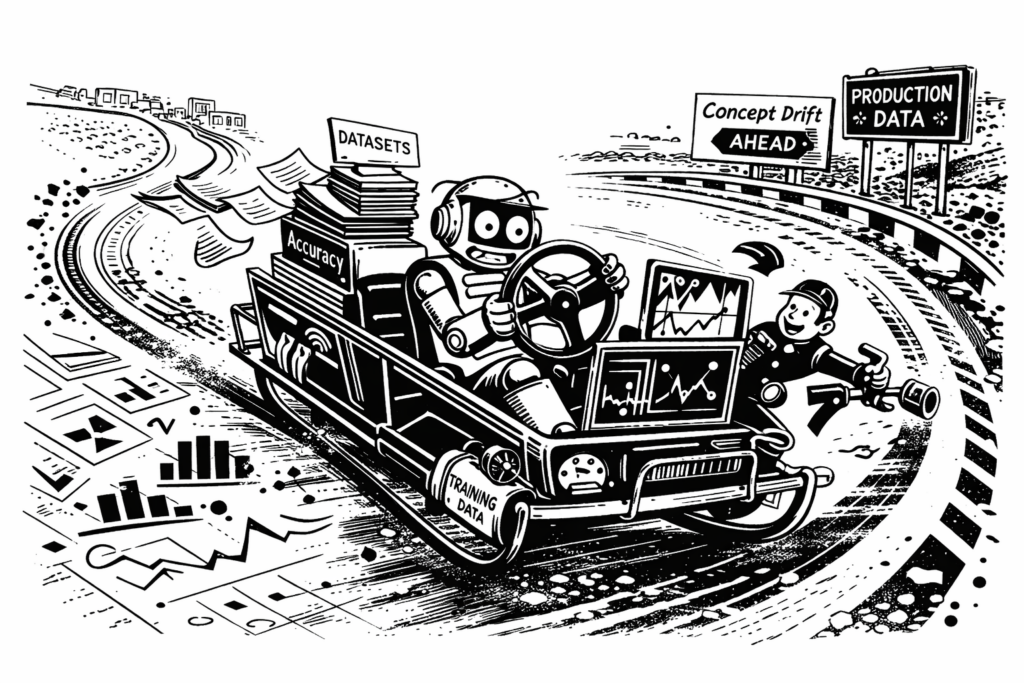

What enterprise leaders need to ask, and answer, before the invoice arrives.
What this article covers:
- Most enterprise AI budgets underestimate true costs by 2-3x once deployment and operations are factored in.
- AI total cost of ownership spans six cost layers: acquisition, infrastructure, training, inference, integration, and talent.
- Data preparation and generative AI governance are the two most commonly missed cost drivers.
- Pilot-stage economics almost never predict production costs; TCO models built on them are structurally flawed.
- AI cost optimization starts with right-sizing compute and treating AI spend as an operational line item.
Q 1. What is AI Total Cost of Ownership, and why does it matter now?
AI total cost of ownership (TCO) refers to the complete financial burden an organization assumes when adopting, running, and evolving AI systems. This spans well beyond the initial licensing or development fee. It accounts for infrastructure, talent, governance, integration, and long-term maintenance across the full AI lifecycle cost.
It matters now because enterprises are committing multi-year AI transformation journeys without a clear-eyed view of what it truly costs to sustain them. Scrutiny from CFOs and boards is rising, and the gap between projected and actual enterprise AI costs is widening. Leaders who understand TCO from the start make smarter build-vs-buy decisions and protect their AI ROI.
Q 2. What is included in AI TCO?
A rigorous AI infrastructure cost breakdown spans six categories:
- Build & Acquisition: The cost of AI implementation, whether licensing a platform, procuring a foundation model, or building custom, is just the entry point.
- Infrastructure: AI infrastructure expenses include compute (GPUs, TPUs), storage, networking, and platform fees. The choice between cloud AI vs on-premise AI cost is a major fork: cloud offers elasticity while on-premise offers control but higher upfront capital.
- Training vs. Inference: AI model training cost vs inference cost are distinct. Training is intensive and periodic; the cost of running AI models in production (inference) is ongoing and often underestimated at scale.
- Integration & Deployment: AI deployment cost includes connecting models to existing data pipelines, APIs, and enterprise systems, frequently the most time-consuming and expensive phase.
- Operations & Maintenance: AI maintenance cost covers model retraining, drift monitoring, compliance audits, and platform upgrades. These AI operational costs recur indefinitely.
- Talent & Governance: Data scientists, ML engineers, AI ethics officers, and security specialists are structural costs, not one-time expenses.
Q 3. What are the hidden costs of AI adoption that organizations miss?
The hidden cost of AI adoption is a rarely line item in an initial proposal. The most common blind spots include: data preparation and cleaning (which consumes 60–80% of an AI project’s time), shadow infrastructure that teams spin up outside approved budgets, and vendor lock-in that inflates enterprise AI investment cost over time.
The hidden cost of generative AI adoption adds a new layer: hallucination mitigation, prompt engineering overhead, output quality review, and content governance. These aren’t optional. Organizations that treat generative AI vs traditional AI cost as equivalent miss the operational complexity that large language models introduce.
Q 4. How do organizations calculate AI Total Cost of Ownership accurately?
To calculate AI total cost of ownership, organizations should model costs across three horizons: pre-deployment (discovery, data readiness, procurement), deployment (integration, testing, rollout), and post-deployment (inference at scale, retraining cycles, compliance, and support).
An honest cost analysis for AI transformation also applies a multiplier for organizational change management—training, adoption, and internal process re-engineering— which routinely doubles estimated budgets. The machine learning cost structure shifts significantly between pilot and production, so TCO models built on pilot economics are almost always wrong.
Q 5. Why do AI projects become expensive over time and how can organizations manage it?
The primary driver is the gap between AI training cost vs inference costat scale. What’s cheap in testing becomes expensive in production, especially when usage grows and the underlying model needs periodic retraining as data distributions shift.
Effective AI cost optimization strategies include right-sizing compute resources, deploying smaller fine-tuned models where appropriate instead of large general-purpose ones, and adopting FinOps-style AI infrastructure cost management disciplines. AI budget planning for enterprises should treat AI as a running operational line, not a capital project with a defined end date. A clear AI ROI vs cost analysisframework, revisited quarterly, keeps investment aligned with measurable business outcomes.
TLDR
AI total cost of ownership is the complete, multi-year financial commitment an organization makes when adopting AI, covering infrastructure, deployment, inference, maintenance, talent, and governance. The hidden costs of AI adoption consistently include data preparation, model drift management, integration complexity, and the unique operational overhead of generative AI. Enterprise AI costs are not a one-time capital expenditure but a recurring operational reality. A true AI TCO model spans training vs. inference economics, cloud vs. on-premise tradeoffs, and build vs. buy decisions. Organizations that calculate AI total cost of ownership before committing to scale are better positioned to deliver sustainable AI ROI and avoid budget overruns. Effective AI cost management requires treating AI infrastructure as a living, evolving system; not a project with a fixed end date.
Fulcrum Digital looks at AI economics the way they behave in the real world: through workload complexity, infrastructure use, human review, and the operating controls that determine whether costs stay bounded as adoption grows.
If your organization is contemplating an AI investment, struggling to make sense of runaway implementation costs, or exploring how to build a sustainable AI strategy, you don’t have to figure it out alone.