

Privacy-first architecture is a foundational model for protecting data across enterprise systems.
Privacy-first architecture refers to the intentional design of digital systems, platforms, and infrastructure that embeds data protection principles at every stage, from development and deployment to scaling and governance. This privacy-first approach ensures that sensitive data is collected, processed, stored, and shared in ways that comply with regulations and safeguard user trust. It underpins modern enterprise systems where privacy engineering, security, and accountability are non-negotiable.
Detailed Definition & Explanation
Privacy-first architecture goes beyond basic compliance; it is a mindset and framework that treats privacy as a core design principle rather than an afterthought. Drawing on concepts such as privacy by design and privacy-first infrastructure design, this model integrates technical and procedural controls to minimize data exposure, enhance transparency, and reinforce digital trust.
At its core, a privacy-first framework typically includes:
- Data minimization
- Differential privacy techniques
- Zero-trust access control
- End-to-end encryption
- User consent and transparency mechanisms
This approach is especially critical in industries where platforms are both AI-powered and cloud-native, as privacy needs to be enforced at scale and in real time. As enterprise platforms evolve toward autonomous systems and intelligent workflows, privacy-first software engineering ensures that data privacy architecture remains stable, secure, and adaptable.
FD Ryze, Fulcrum Digital’s AI-powered platform, supports privacy-first digital transformation by embedding governance, access controls, and ethical automation into its core agentic design, ensuring compliance and trust are sustained from infrastructure to insight.
Why It Matters
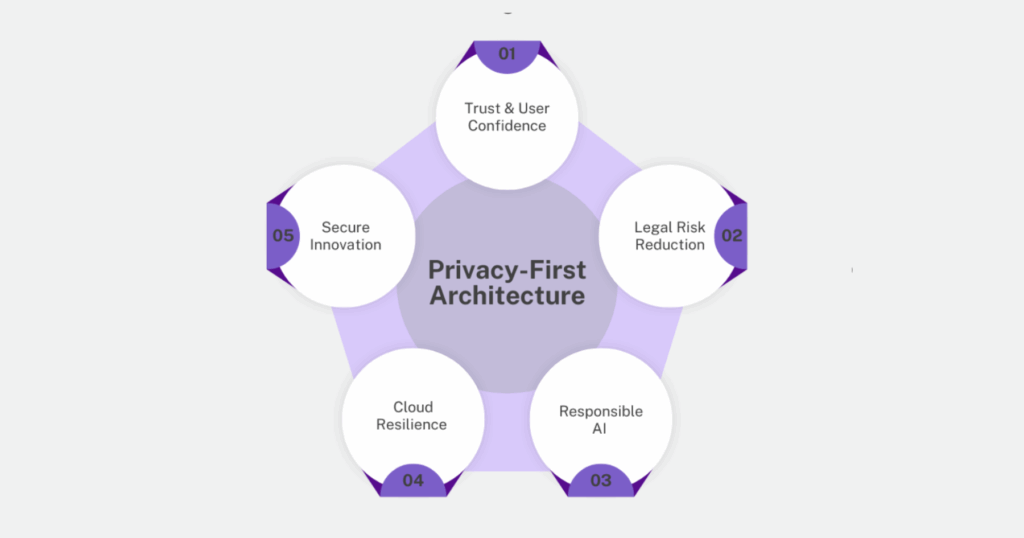
1. Builds Trust in Data-Centric Experiences
A privacy-first design principle fosters user confidence, especially in consumer products and eCommerce, where personalization depends on ethical data handling. Transparent data practices help brands differentiate and maintain loyalty amid growing privacy expectations.
2. Reduces Regulatory and Legal Exposure
Embedding privacy-first compliance architecture into systems from the outset ensures alignment with laws like GDPR and CCPA. This is particularly critical in financial services and insurance, where breaches can carry heavy legal and reputational costs.
3. Supports Responsible AI and Automation
Agentic systems operating in real-time environments must respect privacy at the edge. In sectors like higher education and eCommerce, privacy-first software engineering ensures AI agents operate within legal and ethical boundaries, improving both outcomes and accountability.
4. Future-Proofs Cloud-Native Platforms
A privacy-first architecture for digital transformation gives enterprises the agility to scale while remaining compliant. As more organizations migrate to cloud environments, this framework becomes essential for managing sensitive data across borders.
5. Enables Secure Innovation
When privacy is embedded into infrastructure, teams can develop and deploy faster without needing retroactive controls. This accelerates innovation in regulated industries like insurance and financial services, where both speed and security are critical.
Adoption Trends and Real-World Examples
Enterprise adoption of privacy-first architecture is accelerating as privacy becomes both a strategic differentiator and a risk management imperative. According to the Privacy Risk Study 2023 by the IAPP and KPMG, 93% of organizations now rank privacy among their top ten business risks, with 36% placing it in the top five. This is a clear signal that privacy has moved beyond compliance into the core of enterprise resilience and trust-building. At the same time, Cisco’s 2023 Data Privacy Benchmark Study found that 36% of organizations report achieving at least 2x return on investment from their privacy initiatives, with some noting 3–5x ROI, demonstrating the business value of proactive architecture and governance models.
Yet, there remains significant room for maturity: TrustArc’s 2023 Global Privacy Benchmarks Report found that 74% of companies still see gaps in their current privacy practices, reinforcing the urgency of integrating privacy-first infrastructure design and privacy engineering into cloud-native platforms.
This industry-wide shift has prompted leading organizations to rethink infrastructure from the ground up, embedding privacy into both code and culture. Below are three examples of this approach in action:
- Apple iOS & App Tracking Transparency (ATT)
Apple’s mobile ecosystem enforces user control over tracking permissions by design, reinforcing its privacy-first brand and compliance across global markets.
- Mozilla Firefox & Privacy Sandbox Alternatives
Mozilla continues to invest in architecture that prioritizes anonymity and user choice, positioning itself as a secure alternative in a surveillance-heavy web ecosystem.
- Salesforce Hyperforce & Regional Data Residency
Salesforce’s Hyperforce infrastructure is built to support data residency requirements across regions, enabling customers to store data locally while benefiting from cloud scalability, an approach aligned with privacy-first architecture principles and global compliance mandates.
What Lies Ahead
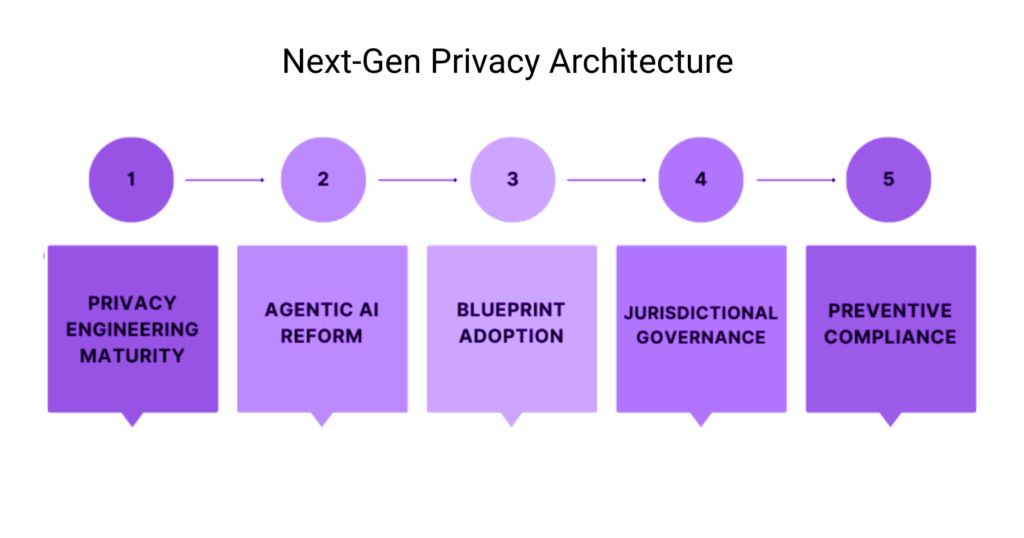
1. Privacy Engineering Will Be a Core Dev Discipline
Privacy-first software engineering will no longer be a niche specialization; it will become integral to enterprise DevOps. This shift is already visible in insurance and finance, where risk-sensitive apps are in constant evolution.
2. Agentic AI Will Drive Architecture Reform
As more platforms deploy AI agents with decision-making authority, architectures must account for ethical and privacy-safe behavior by design. eCommerce and consumer retail platforms using AI for recommendations or fulfillment will need built-in privacy firewalls.
3. Enterprise Platforms Will Adopt Blueprint Frameworks
Organizations will increasingly rely on a privacy-first architecture blueprint for enterprise application platforms to guide infrastructure strategy. This is particularly vital in higher education, where sensitive student and faculty data spans systems and geographies.
4. Privacy-First Will Power Cross-Border AI Compliance
Cloud-native enterprises will require privacy architectures that can interpret and enforce jurisdiction-aware data use in real time. Expect this trend to accelerate in sectors like financial services and insurance.
5. From Reactive to Preventive Governance
The move from patchwork compliance to proactive privacy-first infrastructure design will define enterprise maturity. This will empower companies in consumer products and services and finance to innovate confidently while navigating complex regulatory landscapes.
Related Terms
- Privacy by Design
- Secure Data Architecture
- GDPR Compliance
- Data Governance
- AI Ethics
- Cloud-Native Platforms
- Trustworthy AI Systems