

Data center services deliver managed infrastructure for secure, scalable enterprise computing.
Data center services refer to the suite of infrastructure and operational offerings, including cloud services, data storage, network connectivity, computing and storage, and managed services, that enable enterprises to host, manage, and scale IT workloads. These services support everything from physical infrastructure and virtualization to disaster recovery and AI workload orchestration. In agentic AI contexts, data center services act as the compliant, resilient backbone for deploying intelligent agents and real-time, autonomous digital operations.
Detailed Definition & Explanation
Data center services encompass the physical and virtual infrastructure, systems, and operational capabilities that house and manage enterprise IT workloads. These services deliver foundational components like storage systems, network equipment, and computing and storage capacity, along with advanced support services, network services, and infrastructure services for performance, security, and continuity. They form the critical layer beneath applications, platforms, and agentic AI systems, ensuring uptime, compliance, and resilience. Whether deployed as traditional enterprise data centers, hybrid environments, or modern colocation/cloud models, they are central to scalable digital transformation.
A typical data center service framework operates through the following stages:
• Infrastructure Provisioning
Hardware and virtualized assets such as servers, storage, and networking are allocated to support compute workloads.
• Service Configuration
Resources are configured based on enterprise needs, including OS, virtualization layers, and security parameters.
• Connectivity & Access Management
Establishes network connectivity, access controls, and data routing protocols to ensure reliable, secure communication.
• Operational Monitoring & Support
Round-the-clock monitoring, maintenance, and performance optimization ensure consistent availability and issue resolution.
• Disaster Recovery & Scaling
Backup systems, failover strategies, and elastic provisioning allow for continuity and scalability as demand changes.
Below are some of the key types of Data Center Services:
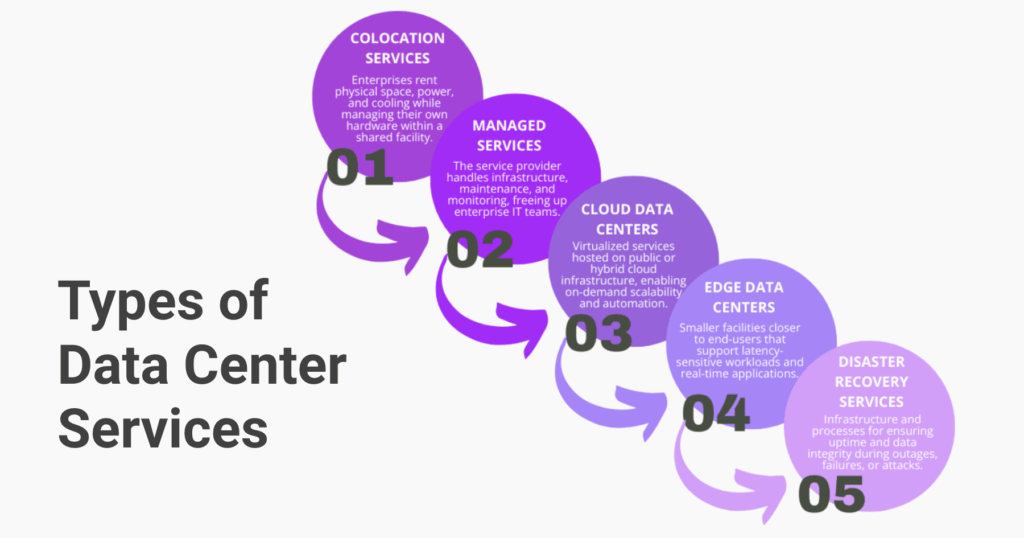
FD Ryze leverages data center services to orchestrate AI workloads across hybrid and multi-cloud environments. Its agentic infrastructure integrates real-time infrastructure services, automates disaster recovery processes, and dynamically manages computing and storage resources across distributed architectures. This enables enterprise agents to scale securely, comply with jurisdictional mandates, and maintain operational uptime without human intervention.
Why It Matters
1. Ensures Business Continuity and Disaster Resilience
Modern data center services offer built-in disaster recovery, failover capabilities, and high-availability infrastructure, all of which are critical for minimizing operational downtime. In financial services and insurance, even a few minutes of outage can result in regulatory violations or millions in losses. With managed resilience, institutions can maintain customer trust and meet compliance mandates without disruption.
2. Supports Secure and Compliant AI Workloads
As enterprises adopt AI-driven automation, data center security and infrastructure services provide the compliance backbone for sensitive data processing. In healthcare and higher education, where personal data is governed by HIPAA, FERPA, or GDPR, secure AI hosting environments ensure that autonomous agents and models operate within ethical and legal boundaries.
3. Enables Scalable Personalization at Lower Cost
By decoupling compute resources from physical constraints, cloud services and elastic infrastructure enable hyper-personalized, AI-powered experiences at scale. For eCommerce, this means adapting in real time to user behavior across peak seasons; for higher education, it means supporting thousands of students with adaptive learning agents and digital campus tools.
4. Optimizes Operations Through Hybrid and Edge Architectures
With support for storage infrastructure, edge computing, and hybrid workloads, data center services allow organizations to run latency-sensitive and distributed applications. This is especially relevant in consumer products and services (CPS) and financial services, where inventory systems, fulfillment operations, and fraud detection tools require low-latency performance without central dependency.
5. Reduces IT Complexity for Digital-First Institutions
Outsourcing to managed services simplifies technology management and speeds up digital transformation without overwhelming in-house IT teams. For insurance providers adopting AI agents for claims or underwriting, and for universities upgrading to cloud-native infrastructure, this means faster deployment, greater agility, and reduced operational risk.
Adoption Trends and Real-World Examples
As enterprise workloads grow in scale and complexity, driven by AI, cloud-native apps, and edge computing, the demand for robust data center services is accelerating. Estimates for the value of data centres worldwide in 2025 range from USD 270 billion to USD 386 billion, with compound annual growth rates of 10% projected into the early 2030s, when the market could surpass USD 1 trillion. This surge is being driven in part by the rise of generative AI, autonomous systems, and high-performance compute demands, all of which are reshaping how enterprises architect their infrastructure. According to McKinsey, AI-driven workloads are expected to consume over 70% of data center capacity by 2030, prompting new investments in high-density compute, liquid cooling, and secure connectivity solutions.
As demand grows, organizations across industries are adopting data center services to balance scalability, cost-efficiency, and performance. Here are three real-world examples:
• Equinix: A leading data center services company, Equinix provides high-performance colocation and interconnect services. Its data centers support eCommerce and financial services firms with low-latency infrastructure and compliance-ready global interconnection.
• Salesforce Shield: Built into Salesforce’s cloud environment, Shield offers encryption, event monitoring, and audit trails, demonstrating how cloud services can embed data center security directly into enterprise platforms, especially in regulated industries like insurance.
• Microsoft Azure Arc: Azure Arc extends cloud services to on-premises and hybrid environments, enabling organizations in sectors like higher education and consumer products to manage distributed infrastructure while meeting local data residency and compliance requirements.
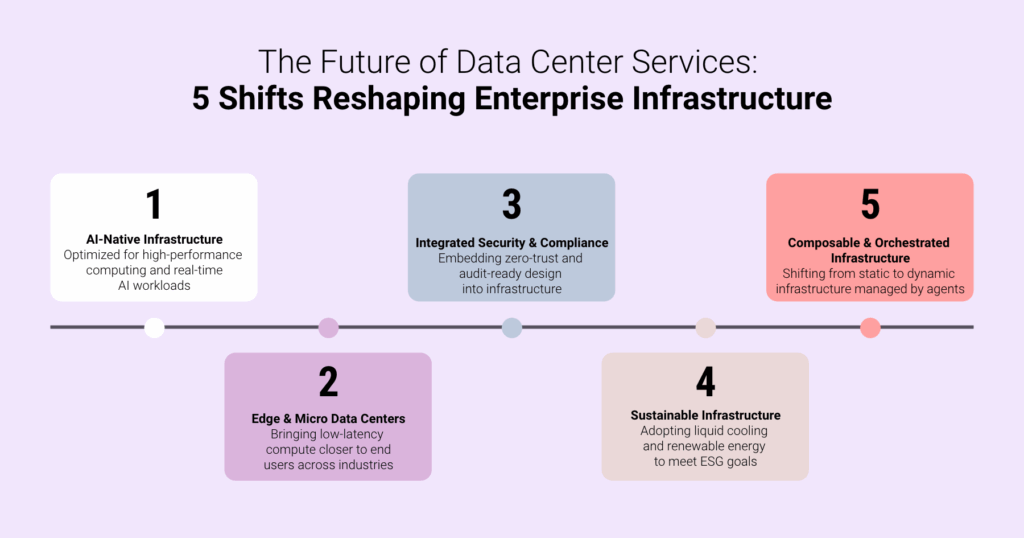
1. AI-Native Infrastructure Will Redefine Capacity Planning
As AI workloads become more compute-intensive, enterprises will need data center environments optimized for GPU clusters, high-bandwidth networking, and real-time scaling. Insurance and financial services organizations deploying intelligent agents for underwriting, fraud detection, or investment modeling must adapt their infrastructure strategies to meet evolving performance and latency demands.
2. Edge and Micro Data Centers Will Power Localized Intelligence
To support low-latency applications like real-time product recommendations or virtual campus services, eCommerce and higher education institutions will deploy edge data centers closer to users. This decentralization improves responsiveness and allows agentic systems to operate autonomously, even in bandwidth-constrained environments.
3. Integrated Security and Compliance Will Become Default
Data center security will shift from perimeter-based controls to embedded, agent-driven safeguards. Enterprises in consumer products and finance must implement zero-trust architectures, real-time audit trails, and policy-aware AI workflows to protect sensitive data and adhere to fast-changing regulations.
4. Sustainable Data Center Design Will Influence Vendor Choice
With energy use from modern data centers rising rapidly, organizations will prioritize partners with renewable-powered operations and advanced cooling systems. For higher education and CPS sectors with ESG commitments, adopting green infrastructure will become both a reputational and operational imperative.
5. Composable, Orchestrated Infrastructure Will Become the Norm
Instead of relying on static configurations, enterprises will shift to modular infrastructure that agents can orchestrate dynamically. This will be especially impactful in insurance and eCommerce, where traffic spikes, regional compliance differences, or partner integrations require agile infrastructure that adapts on the fly.
Related Terms
• Enterprise Data Centers
• Disaster Recovery as a Service (DRaaS)
• Storage Infrastructure
• Edge Data Centers
• Infrastructure as a Service (IaaS)
• Data Center Security
• Hybrid Cloud Architecture
• Network Services