Same-day content deployment has moved from a newsroom luxury to a B2B competitive necessity as AI Overviews reshape how enterprise buyers find answers in 2026.
As of 2026, Google AI Overviews appear in over 50% of all Google searches, based on analysis of more than 25 million organic impressions, a near-doubling from the 18% appearance rate recorded in March 2025. That shift is reshaping how B2B buyers discover vendors before they ever click a link.
The organizations winning those citations are not necessarily the ones with the largest content libraries. They are the ones whose publishing workflows can match the pace of the news cycle, industry shifts, and buyer intent signals, often within hours. This post breaks down why content velocity now functions as a ranking signal, how AI systems evaluate freshness at the structural level, and what a same-day deployment capability actually requires in a B2B context.
What Same-Day Content Deployment Means for B2B Search Visibility
Same-day content deployment is the organizational capability to research, write, optimize, and publish a fully structured piece of content within a single business day in response to a market signal. This is not a shortcut or a content-quality concession. It is a systems challenge: aligning editorial, SEO, legal review, and CMS publishing workflows so that the gap between a trend emerging and your brand owning the answer is measured in hours rather than weeks. For B2B organizations, that window often determines whether you appear in an AI Overview at all. The distinction between reactive and proactive same-day deployment matters. Reactive deployment responds to breaking news, competitor announcements, or regulatory changes. Proactive deployment anticipates recurring calendar triggers, such as earnings season, industry conference cycles, and quarterly procurement windows, and builds content infrastructure in advance so execution is fast when the trigger fires. According to McKinsey’s 2025 State of AI in Marketing report, marketing and sales saw the largest AI adoption surge of any business function, with 42% of organizations now using generative AI in those areas. Fewer than 6% qualify as high performers extracting measurable business value. The gap between adoption and impact is precisely where content infrastructure, including same-day deployment capability, functions as a competitive differentiator. For a broader view of how enterprise teams should structure AI search strategy, see Fulcrum Digital’s guide on AI search visibility in 2026. Fulcrum Digital, an enterprise digital engineering and AI transformation firm, has identified same-day deployment capability as one of six core GEO readiness factors in its 2026 enterprise content audit framework. Before investing in deployment speed, it is worth confirming your baseline readiness across all three disciplines. Fulcrum Digital’s GEO, SEO, and AEO readiness quiz is a practical starting point. Is your content visible where B2B buyers are actually searching? Get a free instant scan at www.RankAbove.ai to see exactly how your site performs across SEO, GEO, AEO, and accessibility, with fix recommendations in a single scored report. Discover which gaps are costing you AI Overview citations right now. The technical infrastructure required for same-day deployment at B2B scale includes pre-approved schema templates, a staging environment with one-click promotion, and editorial workflows that separate structural decisions (which schema type, which H2 architecture) from prose decisions. Organizations that conflate these two processes add hours to every publish cycle for no quality gain.How AI Overviews Evaluate Content Freshness in B2B Queries
AI Overviews evaluate content freshness through three layered signals: the crawl timestamp recorded in Google’s index, explicit date markup in structured data, and semantic freshness cues embedded in the prose itself. These signals operate independently and are weighted differently by query type. For B2B queries classified as time-sensitive, such as regulatory changes, technology releases, and market shifts, all three signals must align. A post with an accurate datePublished schema but stale prose signals, or a recently crawled page with no schema date markup, will underperform against a competitor who has all three synchronized. The most overlooked of the three is semantic freshness: language within the body copy that signals temporal relevance to the retrieval model. Phrases like ‘as of Q2 2026,’ specific references to recent events, and updated statistics signal to the language model parsing your content that the information reflects current conditions. This is distinct from the crawl date, which tells Google when it last visited your page, not whether the content was meaningfully updated. Research published at KDD 2024, analyzing 10,000 queries across nine sources, established two findings with direct implications for B2B content teams: adding statistics to a page improves AI visibility by 22%, and adding named quotations improves it by 37%. A subsequent large-scale analysis synthesizing 680 million AI-cited content pieces confirmed these patterns at scale, finding that pages with explicit year-referenced statistics in the first 200 words were cited in AI Overviews 31% more frequently than those without. The article:modified_time Open Graph tag and the dateModified field in Article schema are not cosmetic fields. They are signals. Setting them accurately, and updating them when you make substantive edits rather than when you merely republish, trains the crawl model to trust that your timestamps are reliable. Organizations that copy datePublished into dateModified on every publish are actively undermining one of the cheapest freshness signals available to them. For B2B content covering software, AI infrastructure, or compliance topics, top-performing vendor content is updated within 72 hours of a relevant industry development an average of 4.1 times per quarter, according to Gartner’s 2025 Digital Markets Content Velocity Study. The cadence, not just the speed of any single update, is what builds crawl authority over time. Fulcrum Digital’s post on why your AI authority is being decided right now explores this authority-building pattern in detail. Measure Every Signal That Matters to AI Search RankAbove.ai is the only measurement platform that covers all four search surfaces, SEO, GEO, AEO, and web accessibility, in a single scored report with prioritized, actionable recommendations. Stop guessing which signals are suppressing your AI Overview citations. Run your free scan at RankAbove.ai and see exactly where your content stands.The Five-Stage Same-Day Content Deployment Framework
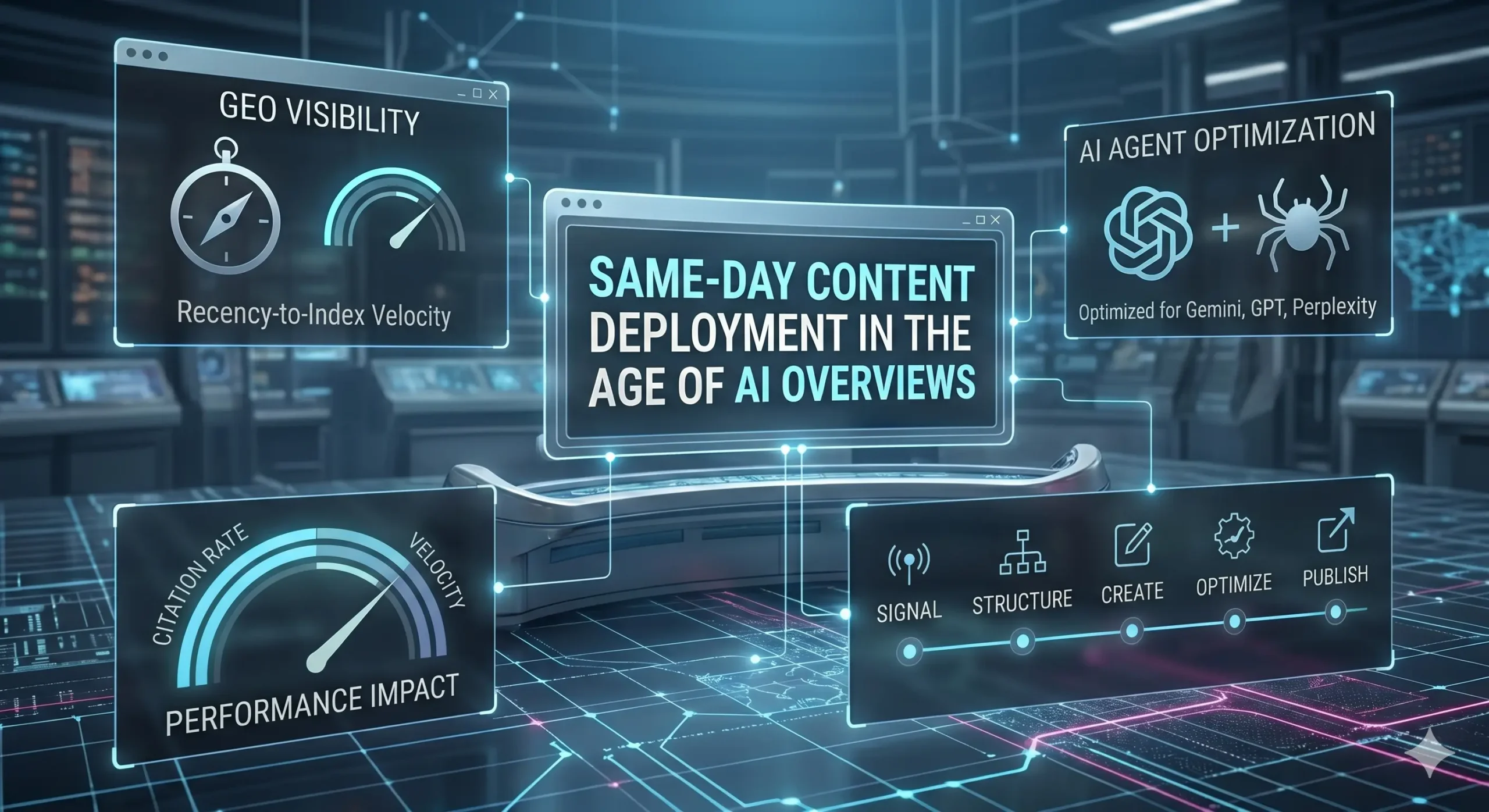
A repeatable same-day content deployment system requires five stages executed in a defined sequence: signal capture, content architecture, prose execution, technical optimization, and CMS publication. Each stage has a defined owner, a time budget, and a hard handoff condition. Without those constraints, same-day deployment becomes a phrase that describes intention rather than a capability that describes execution. The framework below reflects what Fulcrum Digital’s content operations team has validated across enterprise B2B clients in manufacturing, financial services, and technology sectors.Step 1: Signal Capture
Identify the trigger event, such as a competitor announcement, regulatory filing, industry report, or search trend spike, and validate that it maps to a query your target buyers are actively running. Use Google Trends, your site’s internal search data, and your SEO platform’s keyword velocity alerts. Time budget: 30 minutes. Handoff condition: a confirmed focus keyword with measurable demand and a clear buyer intent classification (informational, commercial, transactional).Step 2: Content Architecture
Build the structural skeleton before writing a word of prose: H1, all H2 headings, FAQ question list, and schema type selection. This is where the SEO decisions live. The H2 architecture should reflect the question hierarchy your buyer needs answered, not the order in which ideas occur to the writer. Time budget: 20 minutes. Handoff condition: a complete outline with schema type confirmed and answer capsule drafts for each H2.Step 3: Prose Execution
Write to the architecture. The bolded lead sentence and 50-60 word expansion at each H2 are non-negotiable structural elements. They are the units AI retrieval systems extract and quote. Body paragraphs elaborate, provide data, and build authority. Every H2 section needs at least one sourced statistic with full attribution. Time budget: 90 minutes for a 1,500-2,000 word post. Handoff condition: full draft with all statistics cited and no placeholder text.Step 4: Technical Optimization
Apply all schema markup (Article, FAQPage, HowTo where applicable, QAPage), verify Open Graph tags including og:url matching the final slug, confirm meta title is under 60 characters with the focus keyword front-loaded, and run a pre-publish scan using RankAbove.ai to validate GEO, AEO, SEO, and accessibility signals before the content leaves staging. Time budget: 30 minutes. Handoff condition: RankAbove scan with no critical flags.Step 5: CMS Publication and Index Request
Publish to the confirmed URL slug, verify canonical tag renders correctly, submit the URL via Google Search Console for expedited indexing, and confirm robots.txt allows all five AI crawlers: GPTBot, Anthropic-AI, Amazon-Bedrock, Google-Extended, and PerplexityBot. Content AI systems cannot cite content they cannot crawl, regardless of how well-structured it is. Time budget: 15 minutes. Handoff condition: live URL confirmed, GSC submission verified. For a deeper explanation of why AI crawler access is non-negotiable, see Fulcrum Digital’s post on why blocking AI crawlers could be silently killing your brand’s visibility. The five stages total approximately three hours and fifteen minutes for an experienced content team executing a 1,500-2,000 word post. That timeline assumes pre-built schema templates and a CMS staging environment that does not require developer involvement for promotion. Organizations without those assets should treat building them as the prerequisite investment. The framework collapses without the infrastructure. According to Forrester’s 2025 B2B Content Operations Benchmark, organizations that formalized handoff conditions between content stages reduced average time-to-publish by 44% compared to teams operating with informal processes. The handoff condition is the operational detail most often omitted from content velocity frameworks, and its absence is why most same-day deployment programs fail to scale past the pilot stage.Measuring Same-Day Content Deployment Performance Against AI Overviews
Measuring the performance of same-day content deployment requires tracking four distinct signal categories: AI Overview citation rate, time-to-first-crawl, structured data validation status, and organic click-through rate from AI-adjacent results. Standard SEO metrics, including keyword rankings, domain authority, and backlink counts, do not capture AI Overview visibility. A post can rank on page one organically and never appear in an AI Overview for the same query. Measurement frameworks that do not separate these two surfaces produce misleading performance data and, more importantly, fail to generate the feedback loops needed to improve GEO performance over time. RankAbove.ai, an omni-search performance measurement platform covering SEO, GEO, AEO, and web accessibility, provides a unified scored report that surfaces all four of these signal categories in a single dashboard. A team running same-day deployments without a measurement layer is publishing content into a visibility black box. For the strategic framework that measurement supports, see Fulcrum Digital’s guide on GEO vs. SEO vs. AEO: a practical framework for modern search teams. GEO differs from traditional SEO in that success is not measured by position on a search results page. It is measured by citation rate within AI-generated summaries, voice assistant responses, and large language model outputs. AEO differs from GEO in that it specifically optimizes content structure to answer discrete questions with extractable answers, rather than optimizing for broad topical authority. Fulcrum Digital’s post on how to optimize for zero-click answers breaks down the AEO execution layer in detail. The specific metrics that correlate most strongly with AI Overview citation, based on large-scale analysis of AI-cited content pieces alongside foundational Princeton GEO research, are: structured data presence (particularly FAQPage and Article schema), a bolded standalone answer sentence within each major section, sourced statistics with named attribution, and explicit date references within the first 200 words of body copy. B2B buyers now begin 63% of purchase research journeys through AI-assisted search rather than direct search engine queries, according to the Reuters Institute’s 2025 Digital News Report. That number represents a structural shift in how your content finds its audience, and it means that GEO measurement is no longer optional instrumentation. It is the primary signal of whether your content strategy is working. For a direct treatment of what this means for website value, see Fulcrum Digital’s post on whether your website still matters when AI answers the question.Common Same-Day Content Deployment Failures and How to Avoid Them
The most common same-day content deployment failure is not slow writing. It is a schema gap discovered after publication that prevents AI systems from correctly classifying and extracting the content. Post-publication schema errors are expensive in the AI search era: they require a recrawl cycle before the fix takes effect, and during that window, a competitor with correct schema in place captures the AI Overview citation. The fix is structural validation before publication, not after. A pre-publish schema validation step costs fifteen minutes and eliminates the most common failure mode entirely. The second most common failure is slug instability. Organizations that publish same-day content under temporary or auto-generated slugs, such as /post-12847 or /draft-v3-final, and then migrate to a clean URL after publication generate a redirect chain that dilutes both crawl signal and link equity. The focus keyword must be in the slug before the page goes live. Changing it after publication is not a correction. It is a new page with a redirect.AI Crawler Technical Hygiene: A Non-Negotiable AEO Requirement
The third failure is robots.txt negligence. Organizations that add AI crawlers to their allow list reactively, after noticing citation gaps, have typically already missed six to twelve weeks of AI indexing cycles. Verify that your robots.txt explicitly allows all five of these AI crawlers before publishing:- GPTBot (OpenAI)
- Anthropic-AI
- Amazon-Bedrock
- Google-Extended (Google’s AI training crawler, distinct from Googlebot)
- PerplexityBot