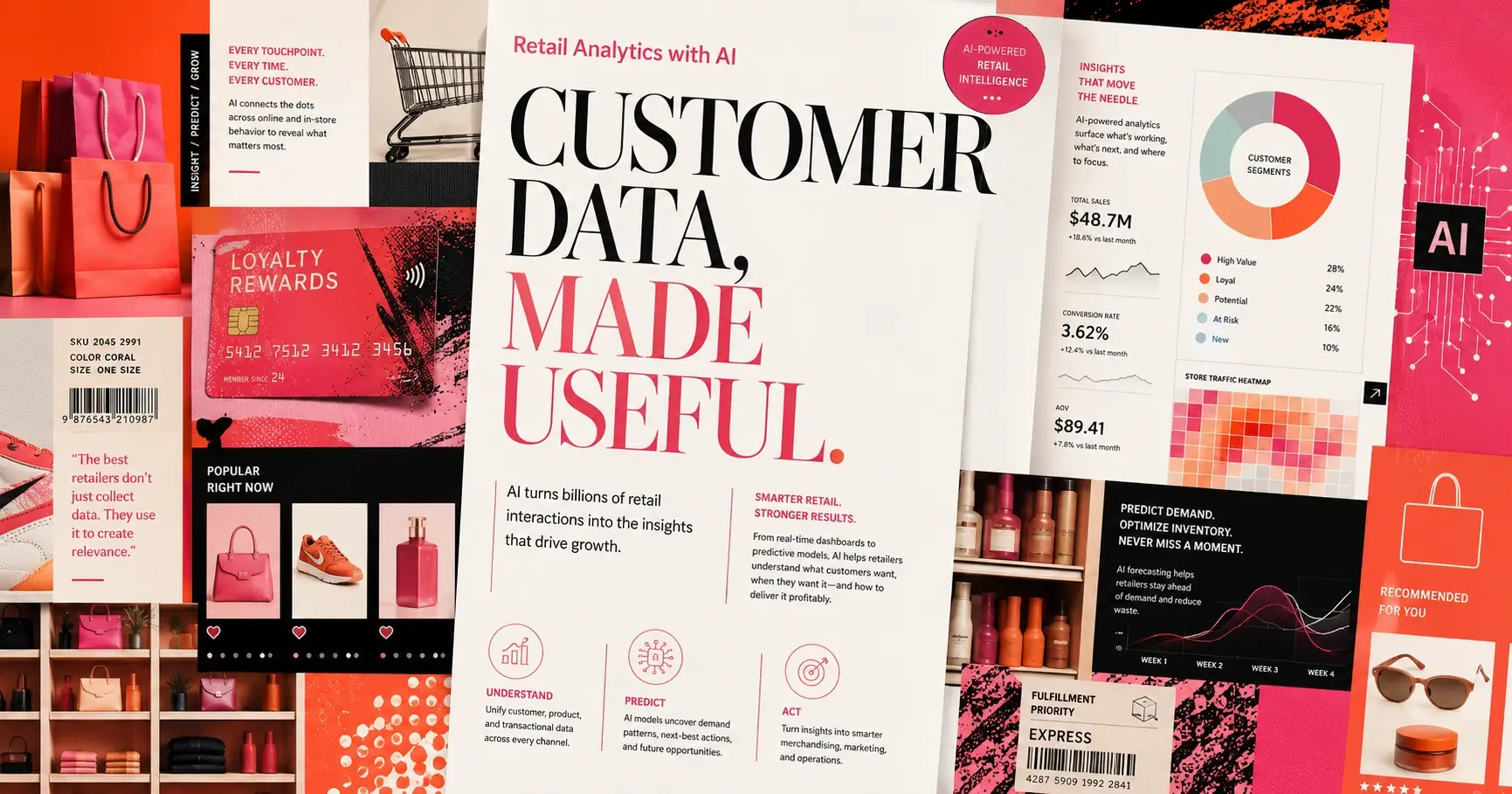
AI retail analytics uses artificial intelligence and machine learning to analyze customer, sales, inventory, ecommerce, store, and operational data so retail teams can identify patterns, forecast what is likely to happen next, and make better decisions across the business.
Retailers are under pressure to make those decisions faster across commerce and store operations. In 2026, AI retail analytics is moving beyond static dashboards into decision systems that connect customer behavior, sales patterns, product performance, and operational signals. Adoption is already mainstream: NVIDIA’s 2026 retail and CPG survey found that 91% of organizations are using or evaluating AI, and 90% plan to increase AI budgets this year.
Here are seven ways AI retail analytics turns customer data into usable retail intelligence.
1. Unified Customer Data Views
AI retail analytics depends on connected, reliable data because customer behavior rarely lives in one system. POS systems, ecommerce platforms, loyalty programs, CRM tools, marketing channels, inventory systems, and store operations each hold part of the picture. Bringing those sources together creates a cleaner view of customer behavior across online and offline journeys.
- Customer 360 profiles: Retail data analytics platforms combine transaction history, browsing patterns, returns, preferences, loyalty activity, and service interactions into unified customer records.
- Omnichannel behavior mapping: Omnichannel retail analytics shows where customers research, compare, abandon, purchase, return, and re-engage across channels.
- Cleaner decision inputs: Retail data intelligence improves when duplicate records, incomplete profiles, and disconnected channel data are cleaned before reaching dashboards or models.
2. AI Customer Segmentation
AI-powered customer segmentation groups customers according to changing behavior, value, intent, preferences, purchase patterns, and churn risk. Retailers can work with segments that respond to what customers are doing rather than relying only on broad demographic categories.
- Behavior-led segments: AI customer behavior tracking identifies patterns such as repeat browsing without purchase, rising category interest, declining purchase frequency, or increased return activity.
- Lifecycle targeting: Customer insights tools can help distinguish first-time buyers, loyal customers, dormant customers, high-value customers, and price-sensitive shoppers.
- Campaign precision: Segmentation can improve personalization, offer timing, retention programs, and product recommendations. Deloitte’s 2026 retail outlook notes that 67% of retail executives expect to have AI-driven personalization capabilities within the next year.
3. AI Sales Forecasting
AI sales forecasting analyzes historical sales alongside current demand signals to estimate what is likely to sell, where, and when. Forecasts become more useful when they account for product, location, channel, and customer context.
- Demand prediction: Predictive analytics models can estimate which products are likely to sell, where demand may rise, and which categories need closer attention.
- Inventory alignment: Forecasts can help reduce stockouts, overstocking, and poor allocation. Oracle’s retail demand planning material highlights factors such as transaction-level data, seasonality, promotions, out-of-stocks, and lifecycle forecasting as key inputs.
- Localized planning: AI-powered store analytics can show how demand differs by region, store format, local customer base, or fulfillment model.
Also read: Top 5 Benefits of AI-Powered Inventory Optimization Services for Retail and Manufacturing to see how AI-powered inventory optimization can improve forecasting, replenishment, stock availability, and inventory visibility.
4. AI Merchandising Insights
AI merchandising insights help retailers understand where assortment, product performance, and commercial decisions need attention. The analysis becomes more useful when sales data is considered alongside customer behavior, margin, availability, trend signals, and local demand.
- Assortment analysis: Retail analytics tools can identify product gaps, slow-moving SKUs, regional demand differences, and category-level performance issues.
- Promotion impact: AI-assisted analysis can compare promotion lift against factors such as margin, stock availability, and repeat purchase behavior.
- Merchant productivity: McKinsey’s 2026 analysis of agentic AI in retail merchandising describes opportunities to reduce time spent on reporting and give merchants more capacity for higher-value decisions, while also noting the organizational changes involved.
5. AI-Powered Retail Dashboards
AI-powered retail dashboards can move beyond displaying performance to helping teams understand where something has changed and what deserves attention. Instead of asking users to interpret dozens of charts, AI-assisted analytics can surface anomalies, explain movement, and draw attention to emerging risks.
- Role-based reporting: Store leaders, merchandisers, ecommerce teams, finance teams, and executives need different views of retail performance.
- Automated insight surfacing: AI-powered reporting tools can flag sudden drops in conversion, rising returns, unexpected category growth, low sell-through, or margin pressure.
- Faster business reviews: AI-powered dashboards can reduce time spent building reports and leave more time for pricing, inventory, marketing, and operational decisions.
- Natural-language analysis: AI-assisted analytics can let merchants, planners, and operations teams ask questions directly of governed retail data and follow up without waiting for a new dashboard or analyst-built report.
6. AI Store and Customer Behavior Tracking
AI-powered store analytics can connect what happens inside a physical location with the commercial outcomes that follow. Computer vision, footfall analytics, shelf monitoring, queue data, POS signals, and store-associate inputs can show where customers move, where they pause, and where sales opportunities are lost.
- Store journey analytics: AI customer behavior tracking can identify high-traffic areas, low-conversion zones, queue friction, and merchandising blind spots.
- Shelf and stock visibility: Store analytics can detect gaps between inventory records and shelf reality, supporting replenishment and availability decisions.
- Offline-to-online linkage: Retailers can connect store behavior with digital engagement, particularly where CRM, personalization, and store experience data need to inform the same customer view.
7. AI-Driven Retail Optimization
AI-driven retail optimization uses analytics to help teams choose between competing actions across pricing, inventory, campaigns, fulfillment, labor, and merchandising. Strong retail analytics platforms give decision-makers a clearer view of the trade-offs behind each option.
- Pricing decisions: AI-assisted analytics can evaluate pricing decisions against demand, competitive conditions, cost, inventory position, and other relevant signals.
- Fulfillment choices: AI can help determine where to source an order based on inventory availability, shipping cost, labor requirements, and delivery expectations.
- Operational prioritization: Retail analytics can help teams identify which issue deserves attention first, whether the pressure is coming from margin, availability, conversion, returns, sell-through, or customer churn.
Retailers do not need more dashboards that describe yesterday’s performance.
They need retail data analytics platforms that connect customer, commerce, inventory, and operational data into usable decision views.
Fulcrum Digital helps retailers build data-driven retail decision platforms that bring these sources together through modern cloud data foundations, unified analytics views, role-based dashboards, and AI-assisted insight surfacing. For retailers trying to turn customer data into confident action, better analytics can shorten the distance between seeing what changed and deciding what to do about it.
Key Takeaways
- AI retail analytics helps retailers identify customer and business patterns faster so teams can work with clearer evidence.
- Retail data analytics platforms are most useful when fragmented information is brought into reliable, usable views.
- AI-powered customer segmentation can respond to behavior, intent, and customer value as those signals change.
- AI sales forecasting can improve planning by helping teams anticipate demand before inventory problems affect performance.
- AI-powered retail dashboards can surface changes earlier and reduce the effort required to investigate them.
- Predictive analytics can support decisions across pricing, merchandising, fulfillment, and store operations.
- AI-driven retail optimization helps teams understand the trade-offs behind competing actions across the business.
Frequently Asked Questions
How is AI retail analytics different from traditional retail BI?
Traditional retail BI is generally built around reporting, dashboards, and known performance metrics, while AI retail analytics can add pattern detection, forecasting, anomaly detection, and more flexible analysis of why performance is changing. The two can work together. Existing BI can provide the reporting foundation, while AI extends the ways retail teams interrogate data, anticipate changes, and investigate emerging issues.
Does AI retail analytics require real-time data?
No. The right data-refresh rate depends on the retail decision being supported. Some use cases—such as fraud detection, inventory availability, or certain customer interactions—may benefit from real-time or near-real-time signals. Customer segmentation, assortment analysis, forecasting, and longer-term planning may work with different refresh schedules. The data needs to be current enough for the decision rather than real-time by default.
How should retailers measure the value of AI retail analytics?
The value of AI retail analytics should be measured against the business outcome the use case was intended to improve. Relevant measures might include forecast accuracy, stock availability, conversion, margin, campaign performance, reporting effort, or time to insight. A single analytics KPI will not represent every use case. The measure should reflect the retail decision the analytics capability is meant to improve.
What should retailers look for in retail data analytics platforms?
Retailers should look for platforms that can bring relevant customer, commerce, inventory, and operational data into trusted views that match how teams actually make decisions. Important capabilities can include omnichannel analytics, forecasting, customer segmentation, role-based dashboards, governed reporting, data-quality controls, and AI-assisted insight surfacing. Integration with existing retail systems also matters because the usefulness of analytics depends on access to reliable business data.
How can Fulcrum Digital support retail analytics?
Fulcrum Digital helps retailers build the data and analytics foundations needed to turn retail information into usable business decisions. This can include modern cloud data platforms, unified analytics views across commerce and operations, role-based dashboards, and AI-assisted insight surfacing with governed logic. Explore our Retail Technology & AI Services to see how these capabilities fit within Fulcrum Digital’s broader retail technology offering.