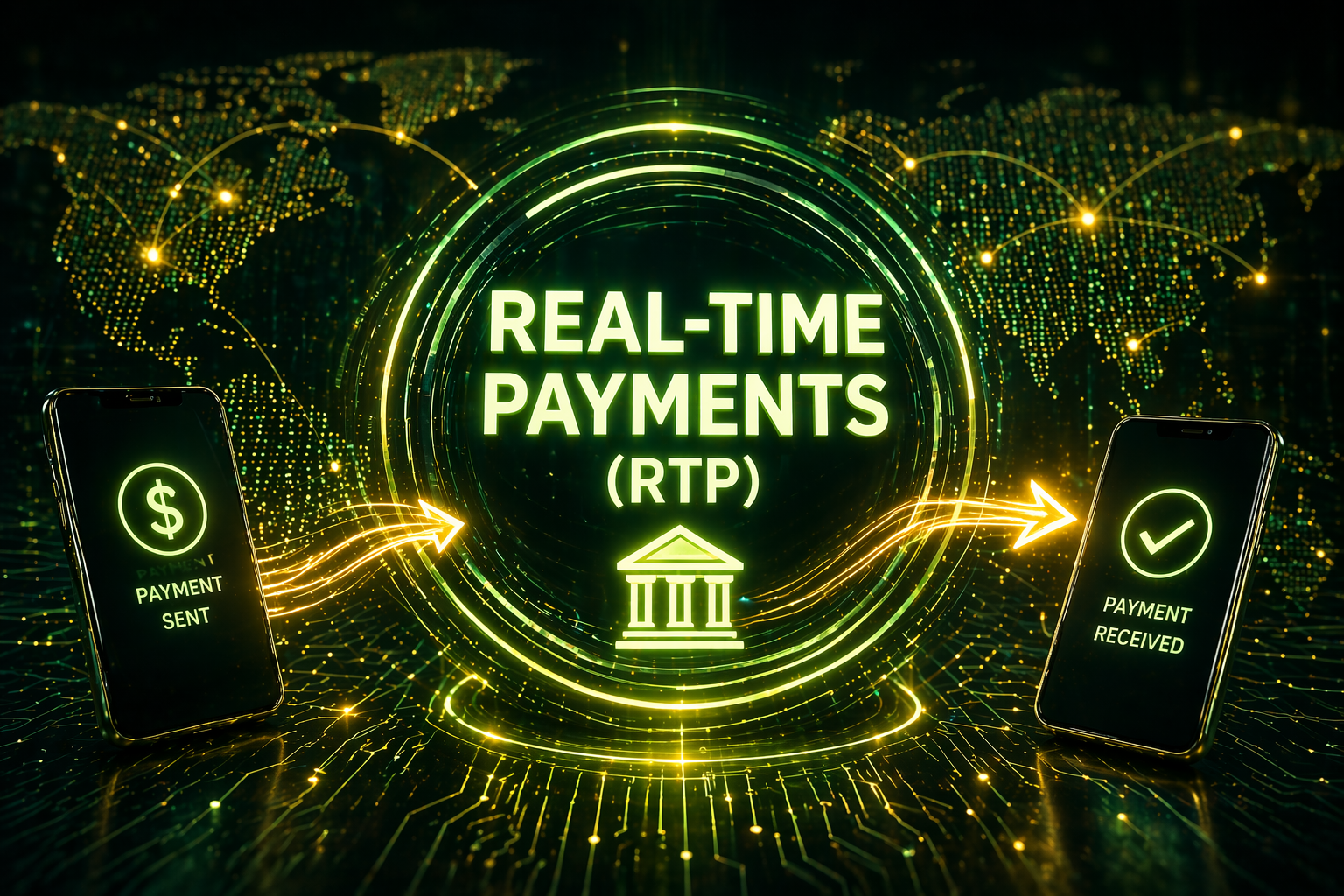
Real-time payments (RTP payments) are electronic transactions where money moves from one account to another within seconds, with immediate confirmation and availability of funds. Unlike traditional transfers that depend on batch processing or delayed settlement cycles, instant payments operate continuously, allowing businesses and individuals to send and receive money at any time.
For banks, fintech providers, and enterprises, real-time money transfer is no longer just a convenience feature but is becoming a core expectation within digital payment solutions, shaping how transactions are processed, how liquidity is managed, and how customer experience is delivered in modern real-time banking environments.
What are real-time payments and how do they work?
At a functional level, real-time payments rely on always-on infrastructure that can validate, clear, and settle transactions in seconds. When a payment is initiated, the system performs checks such as account validation, fraud screening, and balance verification in real time. Once approved, funds are transferred immediately and made available to the recipient without delay.
This differs from older payment processing systems where transactions are grouped and settled in batches, often at the end of the day. In contrast, real-time transaction processing ensures that every payment is handled individually and completed almost instantly.
Behind the scenes, this is enabled by an RTP network, which is a dedicated system designed for speed, continuous availability, and secure messaging between financial institutions. These networks form the backbone of modern instant payment systems.
How are real-time payments different from traditional payment systems?
The difference is not just speed but how the entire payment flow is structured.
Traditional systems such as ACH or batch-based transfers operate on predefined cycles. Funds may be initiated quickly, but settlement and availability are delayed. In contrast, instant bank transfers through RTP systems provide immediate confirmation and real-time settlement, meaning the transaction is final as soon as it is processed.
Another key distinction is availability. Real-time payment infrastructure operates 24/7, including weekends and holidays, whereas many traditional systems still depend on banking hours.
This shift changes how businesses think about cash flow, reconciliation, and customer interactions. Payments are no longer events that “complete later”; they are completed in the moment.
Where are real-time payments used today?
Real-time payments are now used across multiple financial and operational scenarios.
In consumer contexts, they support peer-to-peer transfers, bill payments, and everyday digital transactions through mobile apps and online payment systems. In business settings, they enable faster supplier payments, payroll disbursements, and just-in-time fund transfers.
Banks and fintech companies are also embedding RTP into broader fintech payment solutions, including merchant settlements, cross-platform transfers, and account-to-account payments. This allows organizations to move money with more precision and less delay across their operations.
Globally, different regions are building or expanding global real-time payments networks to support domestic and cross-border use cases. While interoperability is still evolving, the direction is clear: faster payments are becoming a standard expectation rather than a premium feature.
What infrastructure supports real-time payments?
Delivering real-time banking requires a combination of modern systems working together.
At the core is the RTP network, which handles transaction routing, messaging, and settlement logic. Surrounding that are fraud detection systems, identity verification layers, liquidity management tools, and integration with core banking systems.
Financial institutions also rely on modern electronic payments systems that support API-based connectivity, allowing them to integrate RTP into mobile apps, enterprise platforms, and third-party services. These systems must operate with high reliability, low latency, and strong security controls, since transactions are irreversible once completed.
As adoption grows, banks and payment providers are investing in more flexible, scalable real-time payment infrastructure to support higher volumes, new use cases, and cross-border capabilities.
What challenges come with real-time payments?
Speed introduces new operational and risk considerations.
Because immediate fund transfer leaves little time for manual review, fraud detection and decision-making must happen in milliseconds. This places pressure on monitoring systems, risk models, and transaction validation processes.
Liquidity management is another challenge. With real-time settlement, funds move instantly, which means institutions must maintain sufficient balances at all times to support outgoing payments.
There are also integration challenges. Many legacy banking systems were not designed for continuous, high-speed processing. Connecting them to modern instant payment systems requires careful system design, testing, and ongoing maintenance.
Finally, cross-border RTP remains complex. Differences in regulation, currency handling, and network interoperability mean that global real-time payments are still evolving, even as domestic systems mature.
What is the future of real-time payments?
The direction of travel is toward broader adoption, deeper integration, and smarter routing of payments.
As more countries expand their RTP capabilities, faster payments are becoming part of everyday financial infrastructure. At the same time, banks and fintech providers are exploring how to connect domestic systems into more seamless global networks.
There is also growing interest in adding intelligence to payment flows. Routing decisions, fraud detection, and liquidity management are increasingly being optimized using advanced analytics and automation, allowing digital payment solutions to operate with more precision and control.
Over time, real-time payments are likely to become the default layer for many transaction types, especially where speed, certainty, and user experience are critical.
Related questions
Are real-time payments reversible once completed?
No. Most RTP payments are final once processed, which is why fraud detection and validation must happen before the transaction is approved.
Do all banks support real-time payments?
No. Support depends on whether the bank is connected to an RTP network and has the infrastructure to handle real-time processing.
How fast are instant payments in practice?
Most instant payments are completed within seconds, though exact timing can vary slightly depending on the network and the institutions involved.
Can real-time payments be used for cross-border transactions?
Yes, but global real-time payments are still developing. Cross-border RTP depends on interoperability between different national systems and regulatory frameworks.
Related terms
Cross-Border Payments
ISO 20022
Digital Wallets
Payment Rails
Transaction Processing Systems
If you’re looking to evaluate or implement real-time payments within your banking and financial services operations, we’d be happy to help. Speak with our specialists to explore how RTP infrastructure, integration, and transaction intelligence can support faster, more reliable payment flows at scale.
Further reading
Cross-Border Real-Time Payments: The Future of Global Transactions
Real-time payments are reshaping how money moves, but the complexity increases significantly across borders. This article explores the operational, infrastructure, and interoperability challenges behind cross-border RTP, along with the technologies and models shaping the next phase of global payment systems.