

Data Analytics for Higher Education leverages AI and agentic systems to unlock campus-wide intelligence.
Data analytics for higher education refers to the use of AI-powered platforms, academic analytics, and institutional data to drive decision-making across campuses. It encompasses student success insights, operational performance, and resource planning, often delivered through agentic systems that analyze and act on data in real time to improve outcomes at scale.
Detailed Definition & Explanation
Data analytics for higher education is a multidisciplinary framework that combines data science, educational research, and institutional strategy to improve how colleges and universities operate. These systems collect and analyze information from admissions, enrollment, academics, finance, and student services to support everything from early intervention to strategic planning.
Traditionally, higher education analytics services provided static dashboards and retrospective reports. Today, AI-driven data analytics for universities deploy autonomous agents across academic and administrative systems to trigger real-time insights and take automated action. These agents help universities move from passive analysis to dynamic decision orchestration, supporting student retention, performance tracking, financial forecasting, and infrastructure planning.
Agentic AI enhances education performance analytics by decentralizing intelligence. Rather than relying solely on centralized teams to interpret trends, agentic systems embed specialized micro-agents across functions, each designed to handle a specific task, such as monitoring dropout risk, reallocating advising resources, or optimizing course scheduling based on engagement patterns.
Types of Higher Ed Data Analytics:
- Academic Analytics
Measures course success rates, learning engagement, and faculty impact to inform curriculum design and accreditation readiness.
- Student Analytics
Tracks academic progress, at-risk behavior, and student services usage to enable targeted interventions and improved retention.
- Campus Analytics
Monitors space utilization, facility maintenance, and campus safety using real-time data from physical infrastructure and IoT systems.
- Institutional Analytics Services
Provide high-level operational, financial, and strategic insights across departments, supporting performance management and policy design.
- Predictive Analytics for Higher Education Institutions
Forecasts enrollment trends, financial aid demand, student outcomes, and workforce readiness to guide long-term institutional planning.
Why It Matters
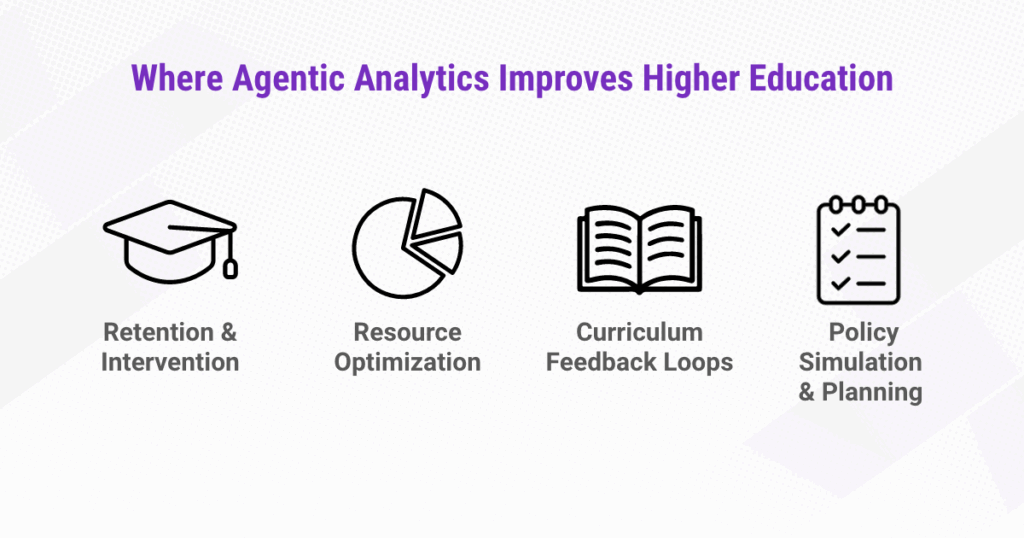
Improves Student Retention and Success Pathways
Agentic systems enable continuous monitoring of engagement signals, academic risk, and support service usage. Micro-agents can automatically flag at-risk students, trigger outreach workflows, and suggest tailored interventions, freeing up advisors for high-impact engagement.
• Optimizes Resource Allocation Across Campus Operations
By analyzing real-time data on classroom usage, staffing patterns, and budget performance, agentic AI agents can help administrators dynamically redistribute resources where they’re most needed. This supports cost-efficiency and adaptive planning during enrollment shifts or staffing constraints.
• Enhances Academic Program Planning with Real-Time Feedback Loops
Academic analytics platforms equipped with agentic capabilities can track student learning outcomes, feedback trends, and faculty performance in real time. Departments can adjust curricula more responsively and identify content gaps before they impact course completion.
• Enables Proactive Institutional Strategy and Policy
Institutional analytics services supported by agentic AI can simulate policy impacts, run what-if scenarios, and alert leadership to emerging risks (e.g., declining enrollment in key programs). This supports faster, evidence-based decision-making at the executive level.
Real-World Examples
As universities face tighter budgets, shifting student expectations, and increasing accountability, agentic and AI-powered analytics platforms are becoming foundational to transformation. These examples highlight practical adoption:
Civitas Learning
Civitas offers AI-driven student analytics platforms that use predictive modeling to inform retention strategies. Its systems continuously analyze behavior and performance trends to support faculty, advising teams, and institutional planning.
Microsoft Education Insights
Integrated into Teams and Microsoft 365, Education Insights provides academic analytics and student engagement tracking. It helps educators understand participation levels, assignment performance, and collaboration dynamics, supporting inclusive learning environments.
FD Ryze
FD Ryze provides agentic AI-powered data analytics services for colleges and universities. It deploys task-specific agents across admissions, student success, and finance workflows, enabling real-time interventions, policy impact simulations, and audit-ready reporting without overwhelming centralized teams.
What Lies Ahead
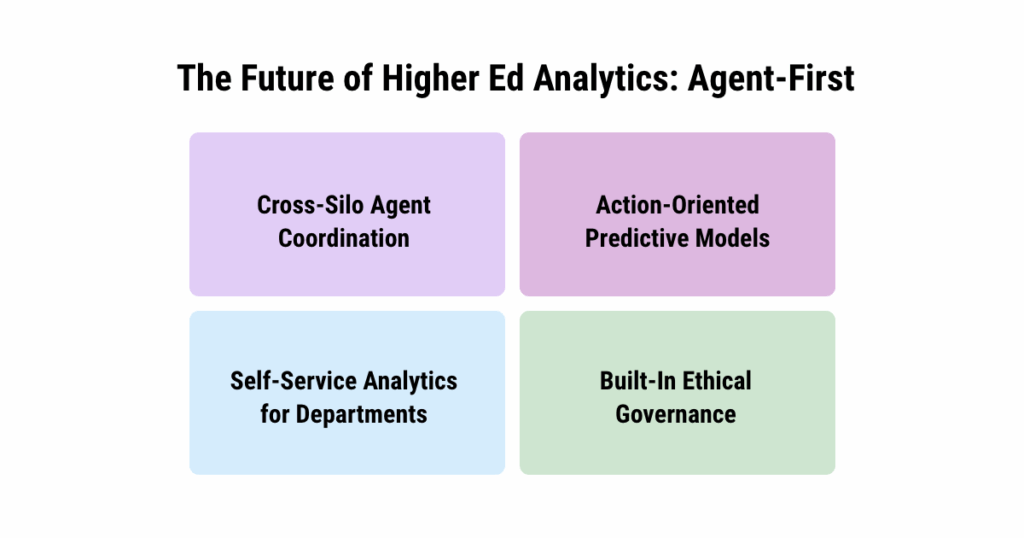
Agent-Based Coordination Across Academic and Administrative Silos
Micro-agents will increasingly bridge data gaps between academic advising, financial aid, enrollment, and mental health services. These agents will coordinate interventions based on context, not isolated rules, reducing duplication and blind spots.
• Predictive Models Will Shift from Reporting to Action
Predictive analytics will evolve from dashboards into autonomous decision layers. When dropout risk rises or class capacity strains, agents will not just alert but schedule meetings, adjust course offerings, or allocate staff as needed.
• Decentralized Intelligence Will Empower Non-Technical Teams
Agentic AI will allow departments like student affairs or registrar offices to run their own analytics without IT mediation. Agents will generate insights, test scenarios, and initiate tasks, democratizing access to institutional intelligence.
• Ethical Governance Will Be Built into Analytics Workflows
As data usage grows, agentic systems will embed safeguards to ensure responsible use. Agents will enforce FERPA constraints, monitor bias in predictive models, and create transparent audit trails for every decision.
Explore strategies for moving higher education beyond generic AI. Download the whitepaper.
Related Terms
- AI-powered Analytics Platforms
- Academic Analytics
- Predictive Analytics for Education
- Student Success Platforms
- Institutional Research
- Agentic AI in Higher Education
- Intelligent Tutoring Systems
- Campus Automation
- Education Data Platforms