

Digital accelerators fast-track AI-driven transformation with modular, agent-ready tools in modern enterprises.
Digital accelerators are modular technologies, frameworks, or AI-driven tools that rapidly enable enterprise transformation. In Agentic AI, digital accelerators often take the form of deployable agents or orchestration layers that fast-track automation, intelligence, and cross-functional outcomes without rebuilding legacy systems.
Detailed Definition & Explanation
Digital accelerators refer to pre-built software components, microservices, or AI-powered capabilities that speed up digital transformation initiatives within enterprises. They are designed to reduce implementation timelines, minimize risk, and enhance agility when adopting emerging technologies, especially AI, cloud, and low-code platforms, which are key enablers of IT service transformation and cloud infrastructure support across modern enterprises.
In traditional IT, accelerators might include reusable APIs, automation templates, or UI frameworks. But in the context of Agentic AI, digital accelerators take on new forms, often as autonomous agents, orchestration logic, or plug-and-play decisioning modules that can be embedded within existing workflows.
These accelerators serve as:
- Deployment shortcuts for intelligent workflows
- Capability enablers for task execution, integration, or analytics
- Change agents that reduce reliance on large-scale platform rewrites
Rather than “starting from scratch,” teams use accelerators to compose, extend, or retrofit intelligent systems that are modular, scalable, and compliant with evolving business needs, often reducing the reliance on traditional platform implementation services.
Structurally, digital accelerators in Agentic AI are composed of modular components such as pre-configured agents, API adapters, orchestration logic, and governance layers. They can be categorized into several types:
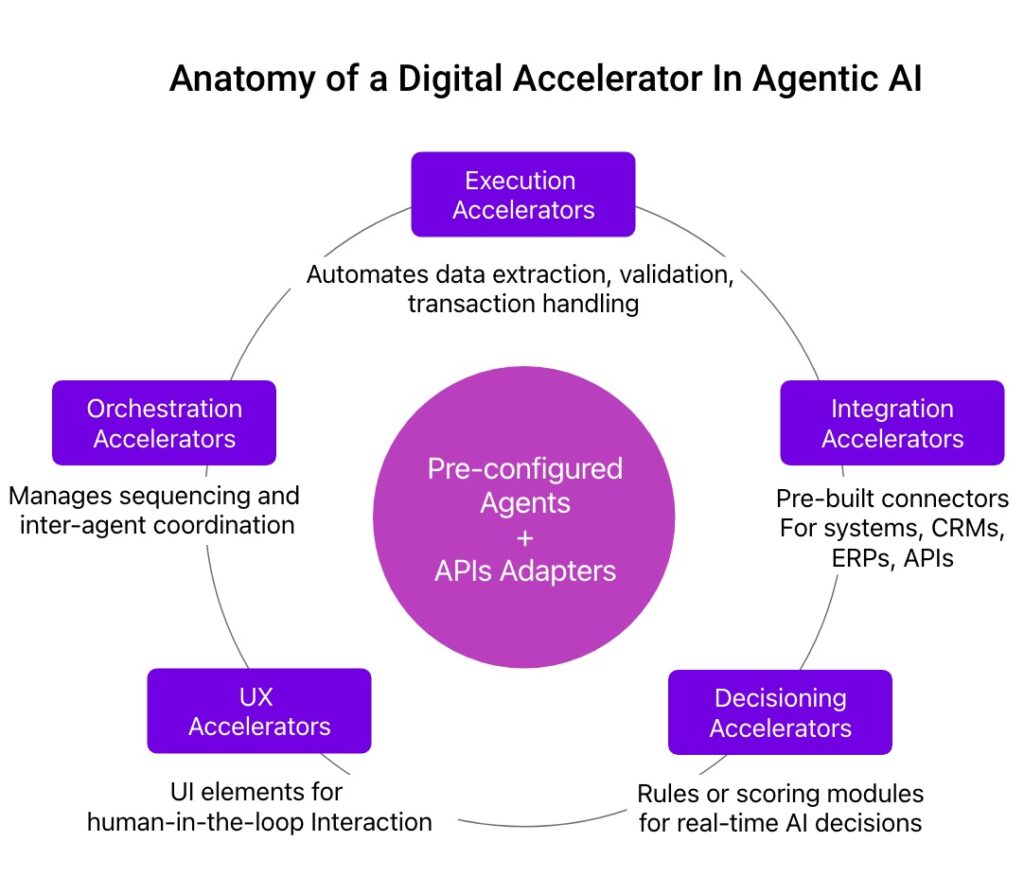
These components are designed to be composable, portable, and agent-compatible, enabling fast deployment without deep customization or infrastructure disruption.
Why It Matters
Reduces Time-to-Value for AI Initiatives
As digital accelerators for enterprise growth, agents or pre-built modules expedite rollouts of use cases like claims routing, invoice processing, or student record validation. Instead of spending weeks on custom development, teams can deploy accelerators that are pre-configured with business logic, integration endpoints, and compliance hooks, reducing deployment timelines from months to days.
- Enables Scalable Modularity
Instead of rigid automation scripts, digital accelerators in Agentic AI adapt to different contexts via embedded reasoning and policy constraints, forming the core of advanced AI/ML automation solutions. This modularity allows organizations to compose solutions like Lego blocks, reusing agents across departments (e.g., onboarding, KYC, or procurement) while allowing each to operate with domain-specific intelligence.
- Decreases Technical Burden
Accelerators simplify enterprise integration with existing systems through APIs, webhooks, or data-layer abstraction, making them low-lift for IT teams. They also reduce dependency on full-stack developers or long project cycles, enabling business units to self-serve AI components via no-code/low-code interfaces or pre-certified deployment templates, thereby streamlining end-to-end quality engineering for digital products.
- Supports Continuous Innovation
Enterprises can experiment with and deploy new workflows without disrupting legacy environments, thereby unlocking iterative, safe transformation and speeding up legacy modernization efforts. With accelerators acting as plug-ins, teams can A/B test different agents, pilot innovations in production environments, and scale successful use cases rapidly, demonstrating how to modernize legacy systems with minimal disruption.
- Builds the Foundation for Agentic Systems
Digital accelerators are often the building blocks for broader Agentic AI ecosystems, enabling orchestration, autonomy, and dynamic behavior essential to scalable business platform development. They standardize the behavior, interaction protocols, and governance layers that make it possible for agents to interoperate, laying the groundwork for multi-agent systems, decentralized decisioning, and scalable orchestration.
Market Outlook
The demand for digital accelerators is intensifying as enterprises seek modular, AI-driven solutions to expedite digital transformation. Key market trends include:
AI Infrastructure Spending: According to IDC, accelerated servers are projected to account for over 75% of AI infrastructure spending by 2028, growing at a 42% five-year CAGR. This surge underscores the increasing reliance on specialized hardware to support AI workloads. (IDC)
Data Center Capacity Expansion: McKinsey reports that global demand for data center capacity could rise at an annual rate of 19–22% from 2023 to 2030, driven by the proliferation of AI applications and the need for robust digital infrastructure. (McKinsey & Company)
Digital Transformation Spending: IDC’s Worldwide Digital Transformation Spending Guide indicates that investments in digital transformation technologies, including digital accelerators, are set to reach significant levels, reflecting the strategic importance of these tools in modern enterprises.
FD Ryze, recognized among the best low-code platforms for fast deployment, exemplifies this trend by offering deployable, hyper-autonomous agents that integrate seamlessly into existing workflows, enabling organizations to scale AI adoption efficiently with or without external digital consultancy support.
What Lies Ahead
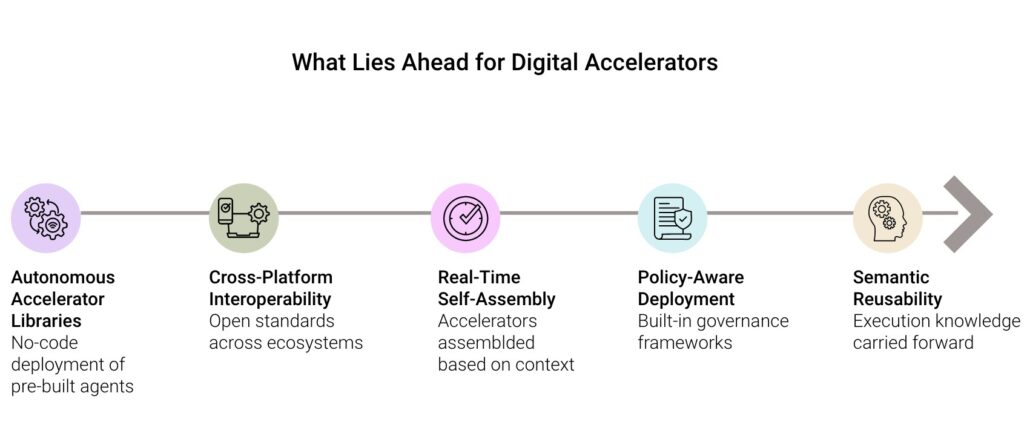
Autonomous Accelerator Libraries: Agentic platforms will offer libraries of pre-built agents that enterprises can deploy and customize on demand: no-code or low-code required.
To prepare, organizations should invest in modular architecture, metadata tagging, and agent registries to support plug-and-play agent deployment.
Cross-Platform Interoperability: Accelerators will increasingly follow open standards (e.g., OpenAPI, GraphQL, Agent Protocols) to function across cloud, hybrid, and legacy ecosystems.
Enterprises should modernize their integration strategy with API gateways, adopt event-driven architectures, and apply platform engineering principles to enable end-to-end DevOps and phase out rigid proprietary interfaces.
Real-Time Self-Assembly: In advanced use cases, agentic systems will auto-select and assemble digital accelerators based on the task, environment, or intent.
This requires building a shared agent context layer, including dynamic discovery protocols, semantic tagging, and orchestration-ready endpoints.
Policy-Aware Deployment: Accelerators will include built-in governance frameworks (e.g., RBAC, audit trails) to ensure secure, compliant AI behavior.
Organizations should define governance-as-code standards and centralize AI policy enforcement mechanisms at both deployment and runtime levels.
Semantic Reusability: Enterprise accelerators will carry metadata and outcome records, allowing future agents to evaluate which accelerators have worked best under similar conditions.
To enable this, companies must adopt workflow observability platforms, track agent performance metrics, and store historical execution context for future reuse.
Related Terms
- Agentic AI
- Intelligent Automation
- Plug-and-Play AI Agents
- Process Orchestration
- Multi-Agent Systems
- Hyperautomation
- Modular AI
- AI Infrastructure
- Enterprise AI Deployment
- Task-Specific Agents