Risk assessment uses AI agents to identify, score, and act on enterprise-level threats in real time.
Risk assessment refers to the process of identifying, evaluating, and prioritizing risks to an organization’s operations, assets, or strategy. In Agentic AI, autonomous agents continuously monitor signals across workflows, enabling proactive mitigation and dynamic risk scoring without manual intervention.
Detailed Definition & Explanation
In traditional enterprises, risk assessment was a manual or rules-based effort executed quarterly or annually by compliance teams, financial officers, or security leads. In contrast, agent-led risk assessment is real-time, distributed, and embedded within everyday operations.
Autonomous agents in Agentic AI systems perform the following key functions:
- Ingest internal and external signals (e.g., transactions, supplier feeds, cyber logs)
- Score risks dynamically using real-time thresholds, models, or regulatory policies
- Trigger mitigation actions autonomously (e.g., flag an order, block a transaction, notify a human reviewer)
- Log assessments for auditability and learning feedback loops
These agents function within defined risk parameters set by human operators but execute decisions based on evolving context. Examples include:
- An underwriting agent adjusting risk scores based on claim history and environmental data.
- A supplier risk agent detecting financial instability or geopolitical exposure through live feeds.
- A data compliance agent flagging potential breaches or anomalies tied to sensitive data flows.

How It Works in Agentic AI
Risk assessment agents operate through an orchestration layer, where context-aware micro-agents continuously evaluate signals and trigger workflows. For example:
- Event Detection: Kafka or Pub/Sub streams detect outliers in behavior or data.
- Model Scoring: Agents invoke models (e.g., fraud detection, anomaly detection) via API.
- Actioning: If thresholds are crossed, agents can freeze workflows, escalate to human reviewers, or execute compensating controls.
Feedback Loops: Outputs are stored in vector databases or graph stores, allowing future assessments to become more accurate over time.
Why It Matters
- Proactive Mitigation Instead of Reactive Oversight
Agentic risk systems assess threats continuously, enabling early intervention before damage escalates. In insurance, this means adjusting policy exposure dynamically. In ecommerce, it could mean blocking a suspicious high-ticket order before fulfillment.
- Context-Aware Scoring Across Domains
Agents analyze not just the risk event, but also surrounding conditions: volume, behavior, prior decisions. In finance, this enables more precise credit scoring. In consumer tech, it helps detect app misuse patterns.
- Dynamic Governance and Compliance
Risk assessment agents integrate with policy insight agents to ensure every action adheres to organizational or regulatory controls. For example, they can cross-check actions against PCI-DSS or HIPAA rules autonomously.
- Cross-Silo Collaboration Among Agents
Agents in procurement, compliance, and finance share risk intelligence. A flagged supplier risk score can pause payments, notify legal, or trigger a contract review without waiting for a manager’s dashboard.
- Auditability and Risk Memory
All agent-driven decisions and risk evaluations are logged. This makes every action traceable, enabling post-event reviews, fine-tuning of models, and better board-level transparency.
Real-World Examples
1. HSBC – AI Risk Detection System
HSBC uses AI agents for fraud and compliance risk assessments. These agents scan millions of transactions and customer records in real time to flag suspicious activity, reducing time-to-detection.
2. IBM OpenPages with Watson
IBM’s GRC platform includes AI-based risk agents that map risks across business functions and automate the scoring and remediation process. It’s widely adopted across finance and healthcare sectors.
3. FD Ryze – Multi-Agent Risk Assessment Engine
FD Ryze deploys a modular risk assessment framework using autonomous agents across claims, procurement, and cyber risk workflows. Its agents scan real-time logs, score risks, and auto-trigger workflow rerouting or stakeholder alerts. This reduces exposure while maintaining compliance across industries like insurance, higher ed, and fintech.
What Lies Ahead
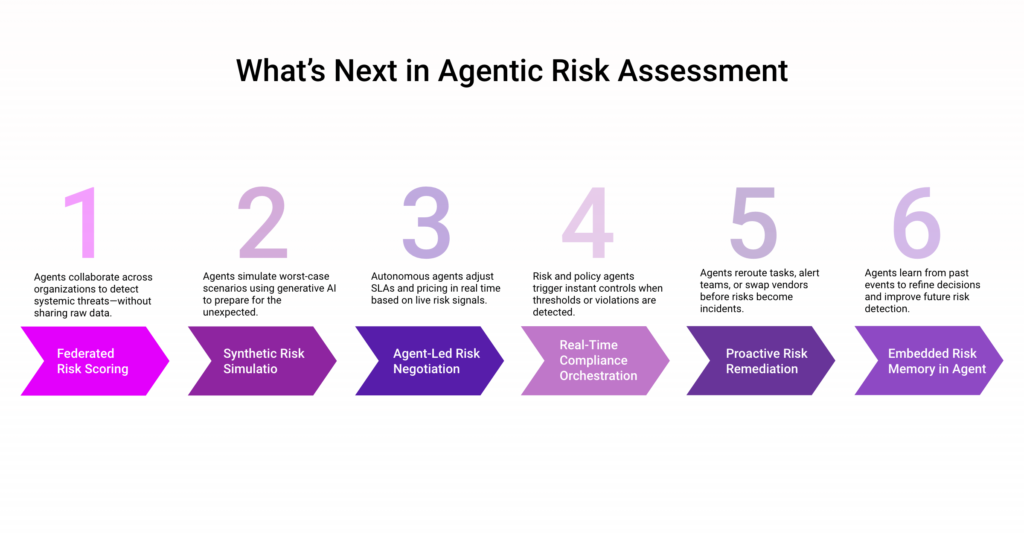
1. Federated Risk Scoring
Autonomous agents across organizations will collaborate securely to assess risks without sharing raw data. Using federated learning and encrypted model updates, they’ll aggregate distributed insights especially relevant in ecosystems like insurance consortia, banking networks, or supply chains where systemic risk can propagate quickly.
2. Synthetic Risk Simulation
Agents will use generative models (e.g., GANs, diffusion models) to simulate edge-case scenarios or unknown variables. For instance, they might model the financial impact of a natural disaster or test cybersecurity defenses under adversarial conditions. This empowers industries like finance, retail, and urban infrastructure to prepare for “unknown unknowns.”
3. Agent-Led Risk Negotiation
In B2B contexts, agents will automatically factor in real-time risk signals like supplier instability or cyber exposure and adjust contract terms, pricing, or SLAs dynamically. These agents will communicate via secure APIs and policy layers, ensuring transparent and just-in-time contract modifications.
4. Real-Time Compliance Orchestration
Risk assessment agents will be paired with policy insight agents to not only detect violations but trigger real-time controls, shutdowns, or escalation procedures based on organizational policy graphs or external regulations.
5. Proactive Risk Remediation
Instead of just reporting risk, future agents will act. For instance, if a vendor’s delivery is delayed due to geopolitical factors, the agent can proactively reroute logistics, notify stakeholders, or onboard an alternative supplier—all autonomously.
6. Embedded Risk Memory in Agents
Agents will retain a risk “memory” across actions, allowing them to adapt decision-making over time. This includes learning from previous near-misses, overrides, or escalations to improve future risk predictions and behaviors.
Related Terms
- Third-Party Risk
- Policy Insight Agent
- Anomaly Detection
- Governance Agents
- Compliance Automation
- Threat Modeling
- Digital Twin Simulation
- Event Stream Processing
- AI Risk Registers