What this article covers:
- AI model drift can weaken production performance even when the model itself has not changed
- Data drift, concept drift, prediction shifts, and upstream data-quality issues require different responses
- Effective model drift monitoring depends on clear baselines, relevant signals, and monitoring cadences suited to the use case
- Drift alerts should trigger diagnosis before retraining, recalibration, rollback, or replacement
- MLOps, observability, governance, and the right monitoring platform are central to long-term model health
AI models do not stop changing once they are deployed, even if the model itself remains untouched. Production data shifts, customer behavior changes, or upstream systems are updated. Over time, the conditions a model encounters can move away from those it learned from, and performance can begin to deteriorate.
AI model drift in production is the change that appears when production behavior moves away from an established baseline. That baseline might be training data, validation data, or a period of healthy production performance.
A drift signal does not always mean AI model performance has already fallen. Changes in inputs or predictions can provide an early warning, while actual performance often requires ground-truth outcomes before it can be measured directly. Current production-monitoring platforms make this same distinction between statistical drift and observed model performance.
The goal of model drift monitoring is to detect meaningful movement early enough to understand what changed and decide what, if anything, needs to happen next.
Here are eight areas every enterprise should have on its radar.
- Know What Kind of Drift You’re Looking At
Different forms of drift point to different problems, so the first task is understanding what has changed.
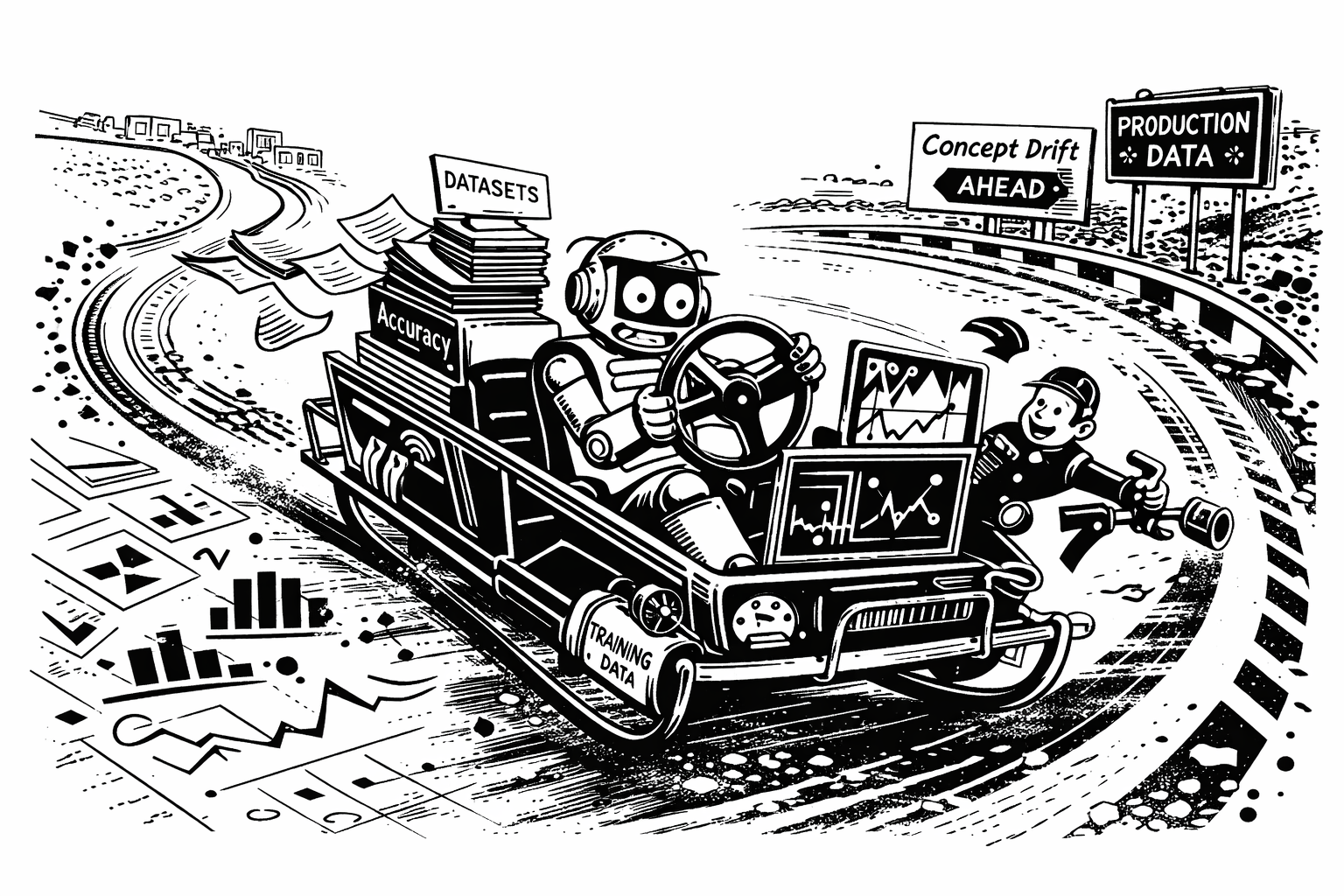
Data drift occurs when the distribution of inputs changes from the chosen baseline. Concept drift goes deeper: the relationship between those inputs and the outcome being predicted has changed. Teams may also see shifts in prediction distributions, missing values, schema errors, or other upstream data-quality problems. These signals can look similar on a dashboard but they require very different responses. It is important to understand the distinction because retraining a model will not fix a broken data pipeline.
- Don’t Wait for Outcomes to Tell You Something Is Wrong
Model drift should be monitored often enough to catch meaningful changes before they begin affecting business results.
That does not mean every model needs real-time monitoring. The right cadence depends on how quickly production data accumulates, how consequential the predictions are, and when actual outcomes become available. For high-volume systems, daily monitoring may make sense. But other models may produce enough data for a useful comparison only weekly or monthly. Current platform guidance reflects this rather than prescribing one universal schedule. Input and prediction drift can provide useful early warnings while teams wait for ground truth.
- Standardize the Signals, Not One Universal Metric
Enterprise teams need consistency in what they monitor, but the same drift metric or threshold will not suit every model.
Useful signals can include:
- changes in input distributions
- movement in prediction distributions
- data-quality failures
- model performance once ground truth is available
- the business outcome the model was deployed to improve
Metrics such as PSI, Jensen-Shannon distance, KS tests, accuracy, precision, recall, or task-specific measures may all have a place depending on the model and data involved. The important part is agreeing on what constitutes meaningful movement for that model and what should happen when the threshold is crossed.
- Build MLOps Infrastructure That Detects Drift Automatically
Model drift detection should sit inside the production ML workflow rather than depend on occasional manual checks.
This is where disciplined MLOps in enterprise AI connects monitoring to deployment, versioning, validation, and model updates. Monitoring should capture the required production data, compare it with the agreed baseline, and alert the right team when something moves outside acceptable limits. Teams also need enough model and data lineage to understand which version generated the affected predictions and what data was reaching it at the time. This makes drift monitoring part of the wider AI model lifecycle, alongside deployment, validation, retraining, rollback, and eventual retirement.
- Layer in Specialized Observability Tools Where Needed
Native platform monitoring may be enough for some environments, while larger or more distributed model estates may need a dedicated observability layer.
The extra tooling should solve a clear problem. That might mean comparing models across several environments, supporting delayed ground truth, examining performance by customer segment, or giving teams one view of drift and model health. Specialized platforms such as Arize and WhyLabs support deeper model-performance and drift analysis, while cloud platforms provide monitoring within their own ecosystems. More monitoring software is useful only when it adds visibility the existing stack cannot provide.
- Diagnose the Drift Before You Retrain the Model
A drift alert should trigger investigation before retraining.
The cause may be a changed data source, expected seasonality, a new customer population, or genuine deterioration in how well the model represents the problem. Check upstream data first. Then compare current behavior with the baseline and, when available, with ground truth. Depending on the cause, the right response may be to fix the pipeline, adjust thresholds, recalibrate the model, retrain it, roll back a recent version, or replace it. Retraining works best when the team knows what it is trying to correct.
- Treat Production Monitoring as a Governance Control
Monitoring also provides evidence that a deployed model continues to behave within the conditions under which the organization approved its use.
That requires clear ownership. Someone needs to review significant changes, determine whether action is required, and record what happened. For some regulated systems, post-deployment monitoring also becomes part of ongoing AI compliance. Article 72 of the EU AI Act requires providers of high-risk AI systems to establish documented post-market monitoring processes that collect and analyze performance data over the system’s lifetime. A broader governance and security framework can connect those monitoring signals to accountability, auditability, and intervention.
- Choose a Monitoring Platform for the Models You Actually Run
A model monitoring platform should match the kinds of models, deployment environments, and monitoring signals the enterprise already needs.
Useful questions include:
- Can it monitor both input and prediction drift?
- Can it measure model quality when ground truth becomes available?
- Does it support the deployment environments you use?
- Can teams investigate alerts rather than simply receive them?
- Does it fit existing MLOps and governance workflows?
Current options include Azure Machine Learning, Google Vertex AI Model Monitoring, Arize, WhyLabs, and other observability platforms. Amazon SageMaker Model Monitor remains available to existing customers but is no longer open to new customers. The best platform is the one that covers the monitoring gaps your model estate actually has.
The Bottom Line
AI model drift in production becomes easier to manage when teams can see change early, understand what the signal means, and respond according to its cause.
Strong production ML monitoring combines early drift signals with actual performance evidence once ground truth becomes available. It also gives teams a repeatable way to investigate problems before they affect the business.
As AI systems become part of live operations, model drift also sits within a wider discipline of enterprise AI monitoring and lifecycle management.
What Next?
Go Beyond Model Drift
Model health is one part of keeping AI dependable after deployment. The Reliability chapter of The Enterprise AI Operating Manual looks at what happens across the wider production environment when data, models, systems, and operating conditions begin to change.
Explore the Enterprise AI Operating Manual
Need a clearer view of model health across your production environment?