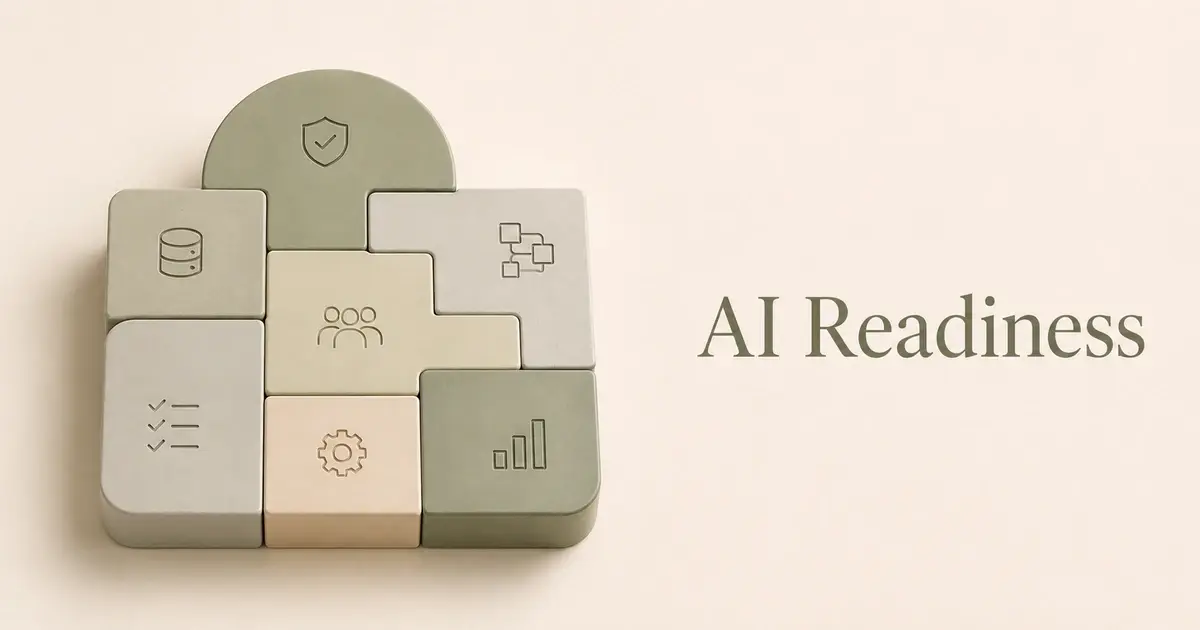
Learn what AI readiness means, what enterprises need before scaling AI, and how data, architecture, governance, workflows, and operating conditions affect deployment.
Quick Answer
AI readiness is an organization’s ability to introduce, operate, and expand AI within its existing business and technology environment. It depends on whether the required data, systems, governance, workflows, ownership, and operating controls are strong enough to support the intended use case.
An organization can have successful AI experiments without being ready for wider deployment. Production introduces dependencies that controlled pilots may not expose, including system access, data quality, security requirements, workflow exceptions, human oversight, and responsibility after launch.
What is AI readiness?
AI readiness describes whether an organization has the technical and operational conditions required to use AI reliably in real business processes.
The term applies to more than access to models or AI tools. Enterprise AI often depends on information held across existing applications, business processes with established owners, security and compliance requirements, and technology that was designed long before current AI capabilities existed. Enterprise AI readiness therefore considers whether those foundations can support the intended deployment.
Important areas include:
- Business objectives and measurable use cases
- Access to reliable enterprise data
- Integration with existing applications and workflows
- Security, permissions, and governance requirements
- Clear ownership across business and technology teams
- Monitoring and operational support after deployment
The required level of readiness will vary by use case. An internal knowledge assistant usually has different dependencies from an AI system that updates records, supports underwriting, processes claims, or participates in financial workflows.
This makes AI readiness a practical question about the environment in which AI will operate and the work it is expected to support.
What does an enterprise need to be ready for AI?
An enterprise needs a clear business use case, usable data, suitable technology foundations, defined governance, workable processes, and ownership for what happens after deployment.
These areas are closely connected.
- Business purpose: The organization should know which problem AI is expected to address and how improvement will be measured. A technically successful deployment has limited value if the business outcome remains unclear.
- Data readiness: The required information needs to be accessible, reliable, appropriately governed, and usable by the AI system. Legacy formats, fragmented sources, inconsistent records, and unclear permissions can limit what a model or agent can do even when the AI capability itself performs well.
- AI architecture: The technology environment needs to support the data access, integrations, models, tools, security controls, and monitoring required by the use case. Architecture also affects how easily an organization can change models or expand into additional AI applications later.
- Governance and security: Teams need to understand who can use the system, what information it can access, which actions are permitted, where human review is required, and how activity will be recorded.
- Workflow readiness: The business process should be understood well enough to identify where AI contributes, where existing automation remains useful, and where people retain responsibility. Undefined exceptions and unclear handoffs often become visible only when a deployment reaches production.
- Ownership and operations: Business, technology, data, security, and other relevant teams need clear responsibilities once the system is live. Someone must own performance, exceptions, changes, access, and decisions about whether the deployment should expand.
A weakness in one area can limit the value of strengths elsewhere. Reliable data has limited impact if the workflow remains unclear, while strong governance cannot compensate for systems that cannot supply the information the AI needs.
How is AI readiness different from AI maturity?
AI readiness asks whether the conditions are strong enough to support a planned AI initiative. Enterprise AI maturity describes how developed and embedded an organization’s AI capabilities have become over time.
An organization can therefore be mature in some areas while remaining unprepared for a particular use case.
For example, a company may already use AI across marketing, analytics, and customer support. A new autonomous workflow involving sensitive financial data may still require additional data access, security controls, integration, and human approval before deployment.
An enterprise AI maturity model provides a broader view of how AI capabilities develop across the organization. A digital maturity assessment examines the wider technology and operating environment, including capabilities that extend beyond AI.
AI readiness sits closer to the deployment decision. It asks whether the organization can support the specific systems and workflows it intends to introduce next. The distinction becomes useful when leaders are deciding whether to move forward, reduce the scope of a use case, strengthen a dependency, or address a larger operating gap first.
How do enterprises assess AI readiness?
An AI readiness assessment turns the requirements of a proposed use case into a structured decision about whether the organization can proceed, what gaps need attention, and which dependencies could limit deployment.
A useful assessment begins with a specific use case rather than scoring the organization against a generic AI checklist.
The process typically involves:
- Defining the use case: Establish the intended business outcome, users, workflow, and level of AI responsibility.
- Mapping dependencies: Identify the data, systems, integrations, people, permissions, and controls the use case will rely on.
- Testing current capability: Determine which dependencies are already in place, which are unreliable, and which do not yet exist.
- Identifying material gaps: Separate issues that would prevent deployment from improvements that can be addressed later.
- Establishing remediation priorities: Determine what should be fixed, integrated, governed, or redesigned before implementation begins.
- Making the deployment decision: Proceed, reduce the scope, sequence prerequisite work, or defer the use case until critical gaps are resolved.
The result should be more useful than a maturity score. It should give teams a documented view of the dependencies that matter to the proposed deployment, the work required to address them, and the decisions that need to be made before moving forward.
A structured AI readiness assessment can also help shape the organization’s AI operating model by clarifying how business, technology, governance, and operational responsibilities need to work together once AI enters production.
What happens when enterprises scale AI before they are ready?
Scaling AI before the operating foundation is ready can expose problems that were difficult to see during experimentation, including unreliable data access, integration failures, growing exception queues, unclear ownership, weak controls, and limited visibility into business performance.
Pilots usually operate within a narrow environment. The number of users is smaller, inputs may be easier to control, and unusual cases can often be handled manually.
Production changes those conditions.
AI begins interacting with more systems, more data, more users, and a wider range of real business situations. Small weaknesses in the underlying environment can become recurring operational problems.
A workflow may technically function while still creating new manual review work. A model may perform well while waiting on data from a legacy application. An AI agent may complete its task while teams remain uncertain about who owns an exception or failed action.
These problems can also make future expansion harder. When every deployment requires custom integration, separate governance, or manual workarounds, adding more AI use cases increases operating complexity.
Readiness work helps identify those dependencies earlier, while there is still room to change the use case, architecture, workflow, or rollout plan.
Continue Exploring
AI readiness gives enterprises a clearer view of what needs attention before investment moves into implementation and scale. The strongest starting point is a specific business use case and an assessment of the conditions required to support it in production.
Fulcrum Digital’s readiness and assessment approach helps organizations examine the business, data, architecture, governance, and operating dependencies around planned AI initiatives and identify where preparation is needed before deployment.
Start Your AI Assessment
Related Reading
AI Readiness Assessment: 3 Decisions to Make Before You Deploy Anything
A practical look at the decisions enterprises need to make before committing to an AI deployment, including the use case, operating conditions, and foundations required to move forward with greater clarity.
Read the full blog
Structural Barriers Holding Back Enterprise AI Adoption
Explore the underlying technology and operating constraints that can slow AI adoption even when organizations have strong executive interest and access to capable AI tools.
Read the full blog
Related Questions
Can an enterprise be ready for one AI use case and unready for another?
Yes. AI readiness is partly use-case specific because different deployments require different data, systems, permissions, workflows, and levels of oversight. An organization may be well prepared for an internal knowledge application while needing substantial additional work before introducing AI into a regulated or transaction-heavy process.
How often should AI readiness be reassessed?
AI readiness should be revisited when the intended use case changes materially, new systems or data sources are introduced, governance requirements change, or the organization plans to expand AI into additional workflows. Periodic reassessment can also identify dependencies that have changed since the original deployment.
Does AI readiness require replacing legacy systems?
No. Legacy technology can affect readiness, but full replacement is not always necessary. APIs, integration layers, data platforms, or phased modernization can sometimes provide the access and reliability an AI initiative requires while core systems remain in place.
Who should own enterprise AI readiness?
Enterprise AI readiness usually requires shared input from business, technology, data, security, governance, and operations teams, with clear ownership for the use case and the final deployment decision. The exact participants depend on the systems, information, and business process involved.
Can AI readiness be measured?
Yes, but a useful measure needs to reflect the requirements of the intended deployment. Readiness assessments can score or classify areas such as data availability, architecture, integration, governance, workflow definition, ownership, and monitoring, then use the results to identify gaps and priorities.
Related Terms
AI Readiness Assessment
Enterprise AI Maturity
Digital Maturity Assessment
AI Operating Model
Digital Infrastructure
AI Governance Policy
AI System Architecture